fbpx

RWA Needs an AI? Why SIX Network Is Bringing AI Into the Protocol

RWA Needs an AI? Why SIX Network Is Bringing AI Into the Protocol

RWA Needs an Assist? | Why SIX Network Is Bringing AI Into the Protocol

The next evolution of RWA is not about putting more assets on blockchain, but about making the underlying infrastructure more intelligent. SIX Network’s 2026 roadmap makes it clear that integrating AI is not about following a trend, but a necessary component for scaling toward institutional-grade operations.


The problem that is often overlooked

Tokenizing real-world assets may sound straightforward. Take a building, a bond, or gold, put it on blockchain to increase transparency and liquidity, and it is done.


In reality, every tokenized asset still relies on a series of manual processes. This includes compliance checks across different jurisdictions, KYC and AML procedures, token holder registry updates, smart contract auditing, and the integration of off-chain data.


Each of these steps carries a risk of human error if there is no system that ensures accuracy and reliability.


At the same time, the global RWA market is growing rapidly. Within just one year, it expanded fourfold, from $6.3 billion in early 2025 to over $25 billion in early 2026, according to RWA.xyz.


The more important question is not just how fast RWA is growing, but whether the current infrastructure is ready to support that level of scale. The answer increasingly points toward AI.


AI + Blockchain: Real use cases already happening

“AI + crypto” is widely discussed, but from SIX Network’s perspective, which is actively studying how AI can be applied to blockchain and RWA, the following are real use cases already happening in the industry and directly relevant to what SIX is building.

1. AI detecting on-chain fraud and suspicious transactions

Elliptic, a specialist in blockchain data analytics, trained AI across hundreds of millions of transactions and reported that money laundering detection accuracy improved to 27% up significantly from a very low baseline. The AI analyzes wallet clusters and transfer patterns to catch anomalies that humans miss. For a protocol managing real institutional assets, this is the baseline of trust that has to exist.

(Source: Elliptic / Blockchain Council, 2026)


2. AI-powered asset valuation and token structure design


Securitize, which received $47M in investment from BlackRock, uses automated systems to assess asset value and design token structures by feeding AI with market data, transaction history, and risk factors. Processes that previously took weeks have been compressed significantly. 


(Source: Suffescom / Securitize, 2026)


3. AI agents automating cross-border regulatory compliance


Zoniqx uses AI agents to continuously monitor and verify KYC/AML compliance and jurisdictional requirements automatically, without waiting for a legal team to review each step. The system operates across multiple countries simultaneously and updates itself when regulations change. This maps directly to what a protocol serving cross-border markets across Southeast Asia needs. 


(Source: Zoniqx, 2025)


4. AI-assisted smart contract writing and auditing

Blockchain Council reports that AI-assisted smart contract auditing is one of the fastest-growing use cases in 2026. Purpose-trained AI can flag potential vulnerabilities before the contract reaches a formal security review, reducing both the time and cost involved at this stage. 

(Source: Blockchain Council, 2026)


5. Institutional funds and assets driven by AI


Franklin Templeton launched the Franklin OnChain U.S. Government Money Fund, the first U.S.-registered mutual fund to record transactions on a public blockchain. BlackRock launched BUIDL, a tokenized money market fund. Both use automated systems to manage compliance and yield distribution. These are real, live examples of institutional-grade RWA where AI and blockchain are already working together. 


(Source: Velvosoft / Franklin Templeton / BlackRock, 2025)


SIX Network and the direction of AI

SIX Network’s position on this is clearly outlined in its 2026 roadmap.


The team is actively researching and preparing to integrate AI with blockchain operations at the protocol level. This is not because AI is a trend worth following, but because the ecosystem being built, whether in institutional asset tokenization, expanding asset diversity on-chain, or PayFi, can function more effectively with AI as part of the system.


More importantly, the infrastructure that SIX Protocol has developed over the years, including the Dynamic Data Layer, automated on-chain compliance, multi-country regulatory support, and token holder registry tracking, creates a structured data environment that AI requires to function effectively.


AI depends on high-quality, structured data. SIX already has that foundation. This is not starting from zero, but building on a system that has been developed with clear intent.


Wherever you sit in this ecosystem


• For asset owners and token issuers, processes that previously required manual effort, such as compliance checks, token holder updates, and investor verification, are moving toward automation. This leads to faster issuance and lower operational costs.


• For those following the SIX ecosystem, the infrastructure that has been built over the years, including SIX Garage, SIX Thruster, and the core SIX Protocol, becomes more valuable as AI is integrated. The structured data accumulated over time is what makes AI adoption practical.


• For developers and builders in Web3, the intersection of AI and RWA infrastructure is still relatively underdeveloped, but this will not remain the case for long.


The direction of SIX Network in 2026

The direction of SIX Network in 2026 is not simply about tokenizing more assets, but about making the entire system intelligent enough to support sustainable, institutional-scale growth.


Real RWA does not stop at putting assets on blockchain. It requires infrastructure that enables those assets to operate intelligently, transparently, and securely around the clock.


AI is the next layer that makes this possible, and SIX Protocol is more prepared to integrate it than most realize.

Follow every update at
Website: https://six.network/
X: https://x.com/theSIXnetwork
FB: https://www.facebook.com/thesixnetwork/


And our community channels:

Discord: http://discord.gg/sixnetwork
Telegram: https://t.me/+0BmqYVoV5j5lN2Jl


• Read the full SIX Network Roadmap 2026: Click

• SIX Network Q1 2026 Summary: Read

⎯⎯⎯⎯⎯⎯⎯⎯⎯⎯⎯⎯⎯⎯⎯⎯⎯⎯⎯⎯⎯⎯⎯⎯⎯⎯⎯⎯⎯⎯⎯⎯

Disclaimer:

1.This article is intended for informational purposes only. Please conduct your own research before making any investment decisions related to cryptocurrencies 2. Cryptocurrency and digital token involve high risk; investors may lose all investment money and should study information carefully and make investments according to their own risk profile.


Don’t miss out follow us at:

Warisara Thepsiri
Warisara Thepsiri

Experience the magic of Blockchain with SIX Network!

Related Posts

SIX Network Q1 2026 Summary Building Blockchain Infrastructure Toward Institutional-Grade Financial Infrastructure

สรุปภาพรวม SIX Network ไตรมาส 1 ปี 2026

เริ่มพัฒนาโครงสร้างพื้นฐาน Blockchain สู่ Financial Infrastructure ระดับสถาบัน ตลาด RWA กำลังเข้าสู่จุดเปลี่ยนสำคัญ ไม่ใช่แค่การเติบโตในเชิงขนาด แต่รวมถึงการเข้ามาของผู้เล่นรายใหม่ ทั้งสถาบันการเงิน ผู้จัดการสินทรัพย์ และองค์กรระดับโลก ซึ่งพวกเขาไม่ได้มองหาแค่ blockchain แต่พวกเขากำลังมองหาโครงสร้างพื้นฐานที่รองรับความต้องการระดับสถาบันได้จริง ทำให้ในช่วงไตรมาส 1 ปี

Read More

How AI and Blockchain Are Already Working Together Today

How AI and Blockchain Are Already Working Together Today

How AI and Blockchain Are Already Working Together Today

In 2024, global investment in AI and blockchain infrastructure exceeded $1.5 billion. This capital came from financial institutions, technology companies, and venture funds that are beginning to treat this convergence not as an experiment, but as a foundation for the next generation of financial systems.


Before AI and Blockchain Worked Together

Think about every time you interact with financial services, whether it is applying for a loan, transferring money across borders, or executing a business agreement.


Most processes still rely on intermediaries, take several days to complete, and involve recurring fees. More importantly, when something goes wrong, it can be difficult and time-consuming to trace the source of the issue.


Now consider what happens when AI is introduced into this system.


In blockchain-based transactions, AI can significantly improve both speed and accuracy. However, this introduces a new question. Who can trust the AI, and to what extent can its decisions be verified if there is no transparent system that explains how those decisions are made?


This is where blockchain becomes critical.


What Happens When AI and Blockchain Work Together


1. AI and blockchain in credit systems under regulatory frameworks


The EU AI Act in 2024 classifies AI systems used for credit scoring as high-risk systems that require clear documentation and auditability. Research published on arXiv in 2025 suggests that blockchain is one of the most suitable tools for creating immutable audit trails for AI decision-making, especially in consumer-facing applications.


Source: EU AI Act / arXiv: Blockchain as AI Transparency Platform


2. Blockchain-based payment systems without intermediaries


In September 2025, SWIFT announced the integration of a blockchain-based shared ledger into its infrastructure, with participation from more than 30 banks. Institutions such as UOB have indicated plans to use this system for ASEAN and cross-border payments, enabling real-time, 24/7 settlement.


Source: SWIFT press release, Sep 2025


3. AI-powered smart contracts for crop insurance


Projects involving Etherisc, Lemonade Crypto Climate Coalition, Chainlink, and Hannover Re have launched blockchain-based crop insurance in Kenya, covering over 7,000 farmers. When drought conditions are detected through environmental sensors, payouts are triggered automatically through smart contracts. AI-powered parametric systems can settle claims within 48 hours, compared to an average of 19 days in traditional systems.


Source: ItisPay / Insurnest


4. Data transparency for AI training


Ocean Protocol has developed a marketplace where data providers can tokenize their datasets and receive compensation each time their data is used to train AI models. In 2024, Ocean merged with Fetch.ai and SingularityNET to form the Artificial Superintelligence Alliance, with a combined valuation exceeding $7.5 billion. This reflects a growing recognition of data as a core asset in the AI economy.


Source: AI Git / Blockchain Council


Signals from Blockchain Industry Leaders

Industry leaders are increasingly aligned on the importance of this convergence.


CZ, founder of Binance, sees AI and blockchain as one of the most important technological convergences of this decade, particularly in identity and automated financial systems.


Vitalik Buterin, co-founder of Ethereum, raises a deeper question about trust. How can AI systems be made verifiable at a fundamental level? His direction points toward using cryptographic proofs, the same foundation that makes blockchain trustworthy, to validate AI processes.


Both perspectives point in the same direction. AI becomes significantly more powerful in financial systems when it is verifiable, and blockchain provides that verification layer.


How SIX Network Sees This Opportunity

From the examples above, it is clear that AI and blockchain are no longer just future concepts. They are already being applied in real financial infrastructure, from credit systems and payment networks to data management and insurance. Together, these developments point to a broader shift, where systems that are automated, accurate, and verifiable are becoming the new standard for the industry.


SIX Network has not only recently started exploring this space. At its core, what we have been building has always been infrastructure designed to support real-world assets, which is exactly where the integration of AI and blockchain can create the most practical and impactful use cases. This includes areas such as on-chain transaction verification, AI-assisted smart contract execution, and the development of systems that can operate autonomously at the infrastructure level.


Whether it is transaction verification on-chain, AI-assisted smart contract execution, or other operational layers, these are areas where real use cases are already emerging.


In the context of RWA tokenization, including real estate, funds, and securities, key questions remain. Can risk be assessed accurately enough? Can compliance be automated reliably? Can systems respond to market conditions in time? 


SIX is actively studying how AI can be integrated into financial infrastructure, not to appear innovative, but because infrastructure that supports institutional-scale projects must be intelligent, automated, efficient, accurate, and trustworthy at the same time.


The Road Ahead for SIX

There are still technical challenges to address. The integration of AI and blockchain at scale within the SIX Network ecosystem will take time.


At this stage, SIX is actively researching how AI can be applied in real blockchain operations to maximize efficiency, both within the SIX ecosystem and in collaboration with partners and future projects.

Follow every update at
Website: https://six.network/
X: https://x.com/theSIXnetwork
FB: https://www.facebook.com/thesixnetwork/


And our community channels:

Discord: http://discord.gg/sixnetwork
Telegram: https://t.me/+0BmqYVoV5j5lN2Jl


• Read the full SIX Network Roadmap 2026: Click

• SIX Network Q1 2026 Summary: Read

⎯⎯⎯⎯⎯⎯⎯⎯⎯⎯⎯⎯⎯⎯⎯⎯⎯⎯⎯⎯⎯⎯⎯⎯⎯⎯⎯⎯⎯⎯⎯⎯

Disclaimer:

1.This article is intended for informational purposes only. Please conduct your own research before making any investment decisions related to cryptocurrencies 2. Cryptocurrency and digital token involve high risk; investors may lose all investment money and should study information carefully and make investments according to their own risk profile.


Don’t miss out follow us at:

Warisara Thepsiri
Warisara Thepsiri

Experience the magic of Blockchain with SIX Network!

Related Posts

SIX Network Q1 2026 Summary Building Blockchain Infrastructure Toward Institutional-Grade Financial Infrastructure

สรุปภาพรวม SIX Network ไตรมาส 1 ปี 2026

เริ่มพัฒนาโครงสร้างพื้นฐาน Blockchain สู่ Financial Infrastructure ระดับสถาบัน ตลาด RWA กำลังเข้าสู่จุดเปลี่ยนสำคัญ ไม่ใช่แค่การเติบโตในเชิงขนาด แต่รวมถึงการเข้ามาของผู้เล่นรายใหม่ ทั้งสถาบันการเงิน ผู้จัดการสินทรัพย์ และองค์กรระดับโลก ซึ่งพวกเขาไม่ได้มองหาแค่ blockchain แต่พวกเขากำลังมองหาโครงสร้างพื้นฐานที่รองรับความต้องการระดับสถาบันได้จริง ทำให้ในช่วงไตรมาส 1 ปี

Read More

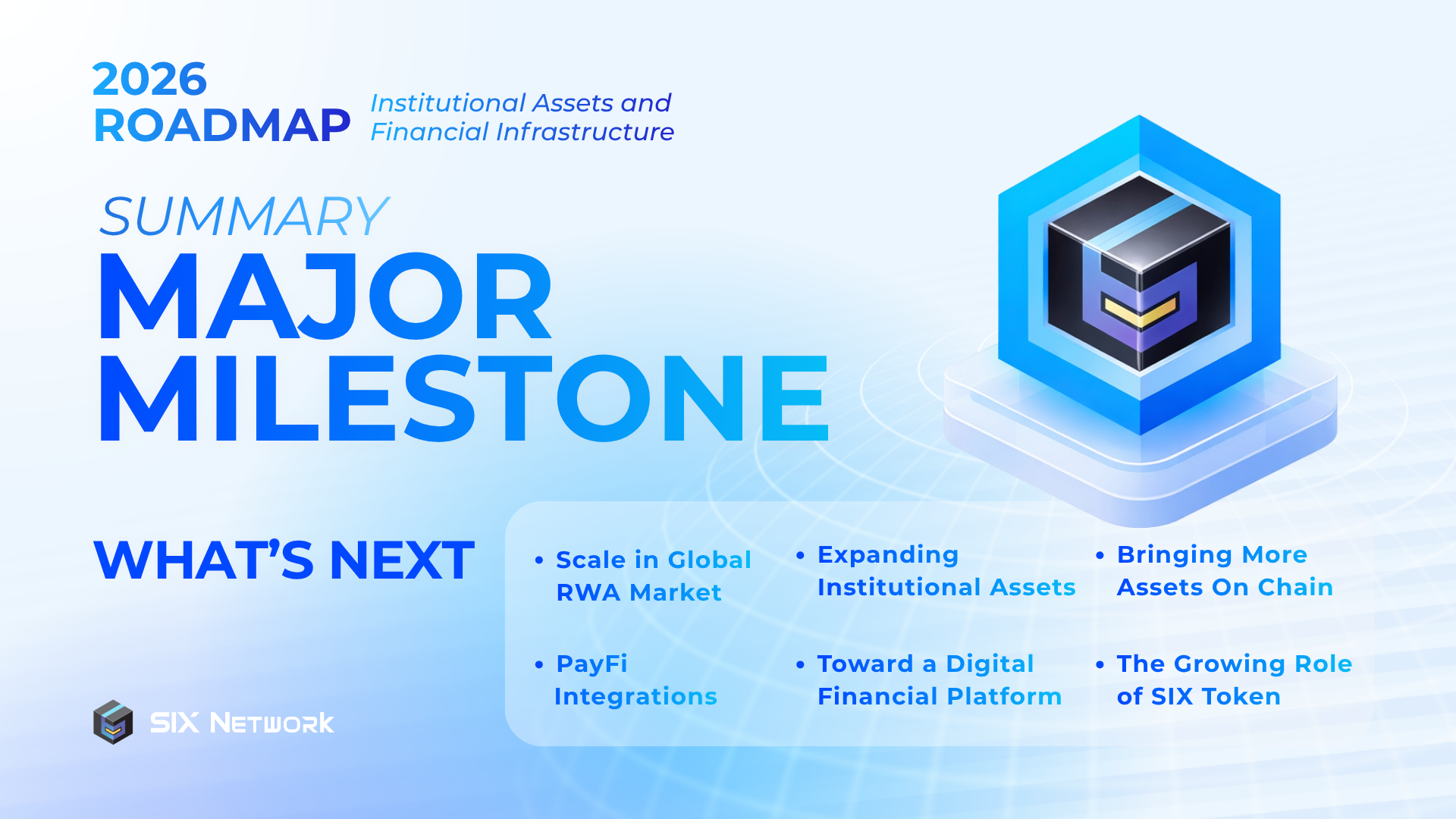
SIX Network Roadmap 2026: Summary Major Milestones

SIX Network Roadmap 2026: Summary Major Milestones

SIX Network Roadmap 2026: Summary Major Milestone and What We Build

Before closing out the SIX Network Roadmap 2026 series, let us wrap things up with a full overview of the milestones and a deeper look into where this year’s roadmap came from, and what the direction we have set is changing within the ecosystem.


Throughout this period, SIX Network has unveiled the 2026 Roadmap across multiple dimensions. If you have been reading this series from the beginning, you will have seen us cover RWA expansion into global markets, the addition of institutional-grade assets, PayFi transforming assets from something held into something used, and the exploration of a Digital Financial Platform that brings everything together.


Each of these directions came through deliberate discussion before becoming part of this year’s roadmap.


This article is the closing piece of the Roadmap series, offering a deep-dive summary to show why these six milestones were chosen specifically, what happens when they work together, and who benefits from it all.


Why Are Institutional Assets and Financial Infrastructure the Major Milestones of 2026?


All six bullets of this roadmap come from milestones that each play a role aligned with our collective goal, particularly in solving foundational problems on the path toward accessible financial infrastructure.


Why does SIX need to scale into the global RWA market?

As we have mentioned often, the RWA market has the potential to grow 4x within a single year. Players who can stay in this game for the long run will find themselves alongside a new wave of participants, whether institutional, investor, or top-tier financial entities. For that reason, expanding into the global RWA market means opening a demand side far larger than before. It is also a condition that every other milestone depends on, because without a broad enough demand, even the strongest assets remain confined to a local market.


SIX Protocol, holding a Global Top 50 RWA Protocol ranking with over $93M in total RWA on-chain, is the foundation that makes this expansion genuinely possible, not just a plan on paper.

Read the article Scale into the Global RWA Market: Click


Why institutional assets?

Financial institutions and institutional investors do not make decisions based on whitepapers. They look at what asset types are already on the protocol, what standards exist, and who has already placed their trust there.


SiriHub2 at THB 2.49 billion and KAVALON Token sold out at 100% are not just case studies. They are signals to the market that SIX Protocol can genuinely support assets at this level. And the more institutional assets that come in, the stronger the pull for more assets and investors of the same caliber to follow.


Read the article Expanding Institutional Assets: Click


Why bring more asset types on chain?

Asset diversity is what allows the entire system to function efficiently within an on-chain RWA ecosystem. The more asset types exist on the protocol, the more new use cases emerge, and the more cross-asset interaction becomes possible. Adding a wider variety of assets on-chain is therefore, an expansion of the surface area of what this ecosystem is capable of.


Read the article Bringing More Assets On Chain: Click


Why connect with PayFi to make assets usable within real financial systems?

PayFi is the concept that bridges blockchain and digital assets with real-world payment and financial systems. If DeFi is about building a new financial system on blockchain, PayFi is about connecting blockchain to the financial systems that already exist, and making them work together in practice.


In the context of SIX Network, exploring PayFi connectivity through partner platforms means that if these connections are established, tokens issued on SIX Protocol would be able to connect with partner platforms that support payment systems or PayFi applications, such as platforms that allow users to put tokenized assets to use in actual financial transactions.


What changes is the reach of tokenized assets on SIX Protocol. They would no longer be limited to SIX’s own ecosystem, but would be able to participate in a broader digital financial landscape through partners built specifically for that purpose.


Read the article PayFi Integration and Connecting with a New Digital Financial Platform: Click 


From all of the above, the path leads toward a digital financial platform.

If you have read this far, you will have started to see how each milestone connects to the next.


As assets expand into global markets, institutional assets come in to add credibility, a diverse range of asset types builds the network, and PayFi connects those assets into real financial systems, the direction naturally arrives at exploring and developing a digital financial platform.


This is what SIX Network is actively looking into and studying the feasibility of, together with regional partners. The vision does not stop at tokenization but extends toward broader financial capabilities.


If this direction becomes reality, what changes is that SIX Protocol would no longer serve only as the starting point for assets. It would support the full lifecycle of digital assets from end to end, from issuance and management through to real financial utility.


All of this contributes to a growing role for SIX Token.

As the ecosystem expands to cover institutional assets and connect with an increasing range of financial systems, SIX Token grows in importance alongside it.


SIX Token’s role within this system is to serve as the coordination layer, supporting governance participation, network access, and broader engagement with the SIX ecosystem, while also driving increased gas usage on-chain from real system activity.


Looking further ahead, this role will become clearer through multiple directions at once, including the growth of on-chain asset value, expanded connectivity with institutional projects, partnerships and activities with platform partners, and wider participation across the ecosystem.


As these components develop together, SIX Token as the coordination layer will become an increasingly central pillar of how the entire system operates, not because anyone has decided it should be important, but because the ecosystem it supports is growing and generating real activity on its own.


Read the article Growing Role of SIX Token: Click


When Every Milestone Connects
What Does the Picture Look Like?

When assets are brought into the system, when those assets meet the quality standards the market expects, and when they can be put to genuine use, what emerges is not just a higher TVL figure. It is a structural shift in the ecosystem itself.


• From isolated assets toward an interconnected system
From holding toward actual use
From experiment toward infrastructure that functions in practice

This is the point at which blockchain begins to serve as true financial infrastructure.


Who benefits, and how?

Investors gain access to credible assets on a system that is transparent and verifiable.

Businesses, organizations, and institutions have infrastructure ready to bring their assets on-chain and build into real use cases from there.

Partners and the broader ecosystem can connect with a system that has real assets, liquidity, and activity behind it.


What to Watch Going Forward

– New assets coming on-chain, in both type and value, that will continue expanding the network effect of the ecosystem.

– New partnerships and ecosystem connectivity with partner platforms, at both institutional and infrastructure levels, bringing global scale from a goal into a reality.

– PayFi access alongside partner platforms, and the development of a digital financial platform, shifting assets from passive holdings into active participants in real financial systems.

– The role and utility of SIX Token becoming more defined. As ecosystem activity grows, the utility of the token supporting it becomes clearer in proportion. 


This has been a full summary of SIX Network’s 2026 Roadmap and the reasoning behind these six milestones. What comes next is the development phase, and we look forward to seeing how it unfolds.

Follow every update at
Website: https://six.network/
X: https://x.com/theSIXnetwork
FB: https://www.facebook.com/thesixnetwork/


And our community channels:

Discord: http://discord.gg/sixnetwork
Telegram: https://t.me/+0BmqYVoV5j5lN2Jl


• Read the full SIX Network Roadmap 2026: Click

• SIX Network Q1 2026 Summary: Read

⎯⎯⎯⎯⎯⎯⎯⎯⎯⎯⎯⎯⎯⎯⎯⎯⎯⎯⎯⎯⎯⎯⎯⎯⎯⎯⎯⎯⎯⎯⎯⎯

Disclaimer:

1.This article is intended for informational purposes only. Please conduct your own research before making any investment decisions related to cryptocurrencies 2. Cryptocurrency and digital token involve high risk; investors may lose all investment money and should study information carefully and make investments according to their own risk profile.


Don’t miss out follow us at:

Warisara Thepsiri
Warisara Thepsiri

Experience the magic of Blockchain with SIX Network!

Related Posts

SIX Network Q1 2026 Summary Building Blockchain Infrastructure Toward Institutional-Grade Financial Infrastructure

สรุปภาพรวม SIX Network ไตรมาส 1 ปี 2026

เริ่มพัฒนาโครงสร้างพื้นฐาน Blockchain สู่ Financial Infrastructure ระดับสถาบัน ตลาด RWA กำลังเข้าสู่จุดเปลี่ยนสำคัญ ไม่ใช่แค่การเติบโตในเชิงขนาด แต่รวมถึงการเข้ามาของผู้เล่นรายใหม่ ทั้งสถาบันการเงิน ผู้จัดการสินทรัพย์ และองค์กรระดับโลก ซึ่งพวกเขาไม่ได้มองหาแค่ blockchain แต่พวกเขากำลังมองหาโครงสร้างพื้นฐานที่รองรับความต้องการระดับสถาบันได้จริง ทำให้ในช่วงไตรมาส 1 ปี

Read More

สรุปภาพรวม SIX Network ไตรมาส 1 ปี 2026

สรุปภาพรวม SIX Network ไตรมาส 1 ปี 2026

SIX Network Q1 2026 Summary Building Blockchain Infrastructure Toward Institutional-Grade Financial Infrastructure

เริ่มพัฒนาโครงสร้างพื้นฐาน Blockchain
สู่ Financial Infrastructure ระดับสถาบัน

ตลาด RWA กำลังเข้าสู่จุดเปลี่ยนสำคัญ ไม่ใช่แค่การเติบโตในเชิงขนาด แต่รวมถึงการเข้ามาของผู้เล่นรายใหม่ ทั้งสถาบันการเงิน ผู้จัดการสินทรัพย์ และองค์กรระดับโลก ซึ่งพวกเขาไม่ได้มองหาแค่ blockchain แต่พวกเขากำลังมองหาโครงสร้างพื้นฐานที่รองรับความต้องการระดับสถาบันได้จริง ทำให้ในช่วงไตรมาส 1 ปี 2026 เป็นช่วงที่ SIX Networkเริ่มวางตัวเองให้ชัดในฐานะโครงสร้างนั้น และขยายสู่ตลาดระดับโลก  


ไฮไลท์สำคัญในไตรมาส 1

• เปิดตัวแผนงานปี 2026 ภายใต้ธีม “สินทรัพย์ระดับสถาบันและโครงสร้างพื้นฐานการเงินดิจิทัล”
• ประกาศความร่วมมือกับ Selanet ผู้พัฒนาโครงสร้างพื้นฐานด้าน AI
• เปิดตัวแคมเปญ “SIX Network Roadmap 2026: Create & Claim Your Rewards”

ขยายบทบาท SIX Protocol ไปยังตลาด RWA ระดับโลก
สู่การประกาศ Roadmap 2026 

SIX Network Roadmap 2026: Institutional Assets and Financial Infrastructure


ในช่วง Q1 ที่ผ่านมา SIX Network ได้มีการพูดคุยกับพาร์ทเนอร์เพื่อขยายความร่วมมือใหม่ๆ รวมถึงหารือในเรื่องของการขยายบทบาทของ SIX Protocol สู่ตลาด RWA ระดับโลก การหารือเหล่านี้เป็นส่วนสำคัญในการกำหนดทิศทางของโปรเจกต์ และนำมาสู่การสรุปแผนงานประจำปี จนออกมาเป็นการประกาศ Roadmap 2026 ภายใต้ธีม “สินทรัพย์ระดับสถาบันและโครงสร้างพื้นฐานการเงินดิจิทัล”

ดยกำหนดทิศทางให้ชัดว่า ecosystem จะมุ่งไปที่การรองรับสินทรัพย์ที่ต้องการในมิติของ

• ความสอดคล้องด้านกฎหมาย (compliance)
• ความโปร่งใส (transparency)
• และการเชื่อมต่อกับระบบการเงินเดิม

พร้อมกันนี้ยังมีการเริ่มศึกษาและพัฒนาแนวทางการนำ AI มาเสริมประสิทธิภาพการทำงานร่วมกับ Blockchain สะท้อนถึงการเตรียมโครงสร้างพื้นฐานที่ตอบโจทย์ความต้องการระดับสถาบันในอนาคต


ประกาศ SIX Network Roadmap 2026 ฉบับเต็ม

ความร่วมมือกับ Selanet: ก้าวแรกของ AI Infrastructure ใน Blockchain Ecosystem ของ SIX Network

SIX Network Announces Partnership with Selanet, AI Agent Infrastructure Developer, to Drive Web3 Ecosystem Growth 

SIX Network ประกาศความร่วมมือกับ Selanet ผู้พัฒนาโครงสร้างพื้นฐาน AI Agent ที่สามารถทำงานร่วมกันบนแพลตฟอร์มได้อย่างเป็นระบบ


ความร่วมมือกับ Selanet นับเป็นจุดเริ่มต้นของการนำ AI infrastructure เข้ามาเป็นส่วนหนึ่งของ ecosystem สอดคล้องกับทิศทางในการประยุกต์ใช้เทคโนโลยี AI กับBlockchain และเป็นสัญญาณที่ชัดว่า SIX Network มองว่า AI และ Web3 จะทำงานร่วมกันได้อย่างมีประสิทธิภาพ 


ประกาศความร่วมมือระหว่าง SIX Network และ Selanet

เปิดตัวแคมเปญ Roadmap 2026 เพื่อสร้างการมีส่วนร่วมของ Community

Celebrate the SIX Network Roadmap 2026 with our campaign Win a total of $1,000 USDT


แคมเปญ “SIX Network Roadmap 2026: Create & Claim Your Rewards” ถูกออกแบบมาเพื่อเชื่อมต่อทิศทางระยะยาวของโปรเจกต์กับการมีส่วนร่วมของผู้ใช้งานในระบบนิเวศ การทำให้แผนงานกลายเป็นสิ่งที่ผู้ใช้สามารถมีปฏิสัมพันธ์ได้จริง ช่วยลดช่องว่างระหว่าง strategy และ execution ในฝั่ง user activity ลงอย่างมีนัยสำคัญ รูปแบบของแคมเปญที่ผสานทั้ง engagement และ incentive เข้าด้วยกัน ยังเป็นอีกหนึ่งกลไกที่ช่วยขับเคลื่อนระบบนิเวศให้เกิดการใช้งานอย่างต่อเนื่อง 

ร่วมกิจกรรม Roadmap 2026 ที่ X @theSIXNetwork

สรุปภาพรวมไตรมาส

ในช่วง Q1 นอกจากเป็นช่วงเวลาของการจัดการและวางแผนของปีแล้ว ยังเป็นการมองหาโอกาส วางบทบาทสู่ตำแหน่งของการเป็นโครงสร้างพื้นฐานระดับ enterprise-grade อีกทั้งยังสร้างความร่วมือใหม่ ๆ ที่สอดคล้องกับทิศทางของ AI รวมถึงการสร้าง community engagement ที่ชี้ไปในทิศทางเดียวกัน ซึ่งในช่วง Q2 ต่อจากนี้และครึ่งปีหลังจะเป็นช่วงที่โครงสร้างเหล่านี้เริ่มแสดงผลลัพธ์ออกมาให้ทุกคนได้เห็นกัน 


ทิศทางต่อไปในปีนี้

สิ่งที่ SIX Network วางไว้ใน Q1 จะเริ่มแสดงผลออกมาให้เห็นในช่วงครึ่งปีหลัง ทั้งในแง่ของ product ที่ชัดขึ้น partnership ที่ขยายออก และ use case ระดับองค์กรที่เริ่มเป็นรูปธรรมมากขึ้น ทิศทางหลักยังคงอยู่ที่การสร้าง financial infrastructure layer ที่พร้อมรองรับตลาด RWA ในระดับโลก และการพิสูจน์ว่าโครงสร้างที่วางไว้สามารถทำงานได้จริงในระดับสถาบัน

หมายเหตุ


1. ประกาศนี้เป็นเพียงเพื่อการให้ข้อมูลเท่านั้น กรุณาศึกษาข้อมูลด้วยตนเองก่อนตัดสินใจลงทุนที่เกี่ยวข้องกับสกุลเงินดิจิตอลหรือการลิสต์โทเค็น

2. คริปโทเคอร์เรนซี และโทเคนดิจิทัลมีความเสี่ยงสูง ท่านอาจสูญเสียเงินลงทุนได้ทั้งจำนวน โปรดศึกษาและลงทุนให้เหมาะสมกับระดับความเสี่ยงที่ยอมรับได้


Don’t miss out follow us at:

Warisara Thepsiri
Warisara Thepsiri

Experience the magic of Blockchain with SIX Network!

Related Posts

SIX Network Q1 2026 Summary Building Blockchain Infrastructure Toward Institutional-Grade Financial Infrastructure

สรุปภาพรวม SIX Network ไตรมาส 1 ปี 2026

เริ่มพัฒนาโครงสร้างพื้นฐาน Blockchain สู่ Financial Infrastructure ระดับสถาบัน ตลาด RWA กำลังเข้าสู่จุดเปลี่ยนสำคัญ ไม่ใช่แค่การเติบโตในเชิงขนาด แต่รวมถึงการเข้ามาของผู้เล่นรายใหม่ ทั้งสถาบันการเงิน ผู้จัดการสินทรัพย์ และองค์กรระดับโลก ซึ่งพวกเขาไม่ได้มองหาแค่ blockchain แต่พวกเขากำลังมองหาโครงสร้างพื้นฐานที่รองรับความต้องการระดับสถาบันได้จริง ทำให้ในช่วงไตรมาส 1 ปี

Read More

SIX Network Q1 2026 Summary: Toward Institutional-Grade Blockchain

SIX Network Q1 2026 Summary: Toward Institutional-Grade Blockchain

SIX Network Q1 2026 Summary Building Blockchain Infrastructure Toward Institutional-Grade Financial Infrastructure

Building Blockchain Infrastructure

Toward Institutional-Grade Financial Infrastructure

The RWA market is reaching a significant turning point, not just in terms of growth in scale, but in the arrival of new players: financial institutions, asset managers, and global enterprises. They aren’t looking for just another blockchain. They’re looking for infrastructure that can truly meet institutional-grade demands. Q1 2026 was the quarter SIX Network began positioning itself clearly as that infrastructure, and expanding toward a global market.


Key Highlights in Q1 2026

• Launched the 2026 Roadmap under the theme “Institutional Assets and Digital Financial Infrastructure”
• Announced a partnership with Selanet, an AI agent infrastructure developer
• Launched the “SIX Network Roadmap 2026: Create & Claim Your Rewards” campaign

Expanding SIX Protocol’s Role in the Global RWA Market
Toward the Announcement of Roadmap 2026

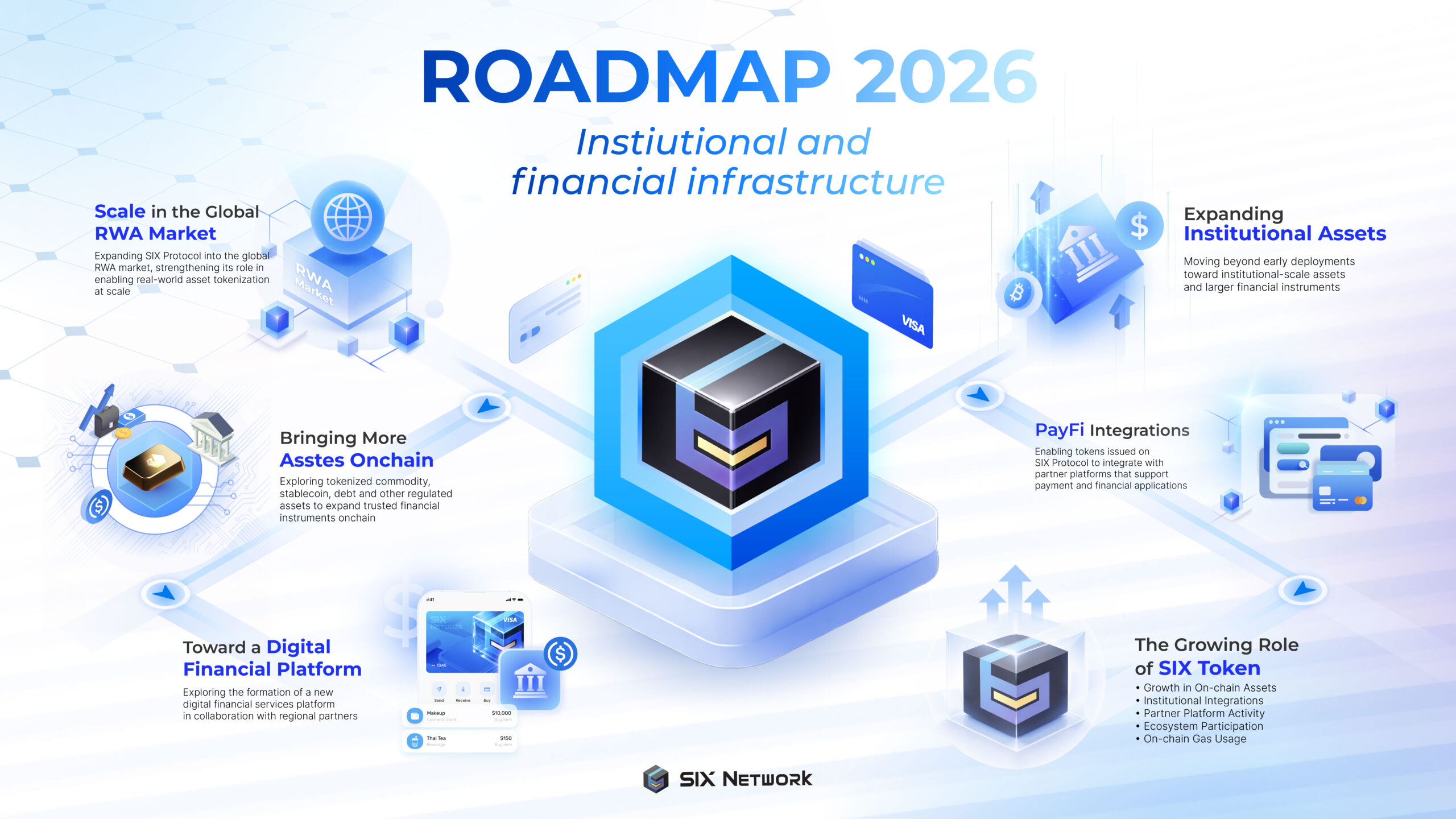
SIX Network Roadmap 2026: Institutional Assets and Financial Infrastructure


During Q1, SIX Network engaged in discussions with partners to explore new collaborations and expand the role of SIX Protocol in the global RWA market. These engagements played a key part in shaping the project’s direction, and ultimately led to the consolidation of our annual plan and the announcement of the 2026 Roadmap under the theme “Institutional Assets & Digital Financial Infrastructure.” 


The roadmap sets a clear direction for the ecosystem: focusing on assets that require compliance, transparency, and seamless integration with traditional financial systems. 


Alongside this, SIX Network has begun exploring how AI can enhance the efficiency of Blockchain operations, reflecting our preparation for infrastructure that meets the demands of institutional-grade use cases ahead.


Full Announcement: SIX Network Roadmap 2026

Selanet Partnership: The First Step of AI Infrastructure in SIX Network’s Blockchain Ecosystem

SIX Network Announces Partnership with Selanet, AI Agent Infrastructure Developer, to Drive Web3 Ecosystem Growth 

SIX Network announced a partnership with Selanet, a developer of AI Agent infrastructure capable of operating collaboratively across platforms in
a structured way.


The partnership with Selanet marks the beginning of bringing AI infrastructure directly into the ecosystem, aligned with the direction of applying AI technology to blockchain, and a clear signal that SIX Network sees AI and Web3 working together effectively

Partnership Announcement: SIX Network x Selanet

Roadmap 2026 Campaign, Building Community Engagement 

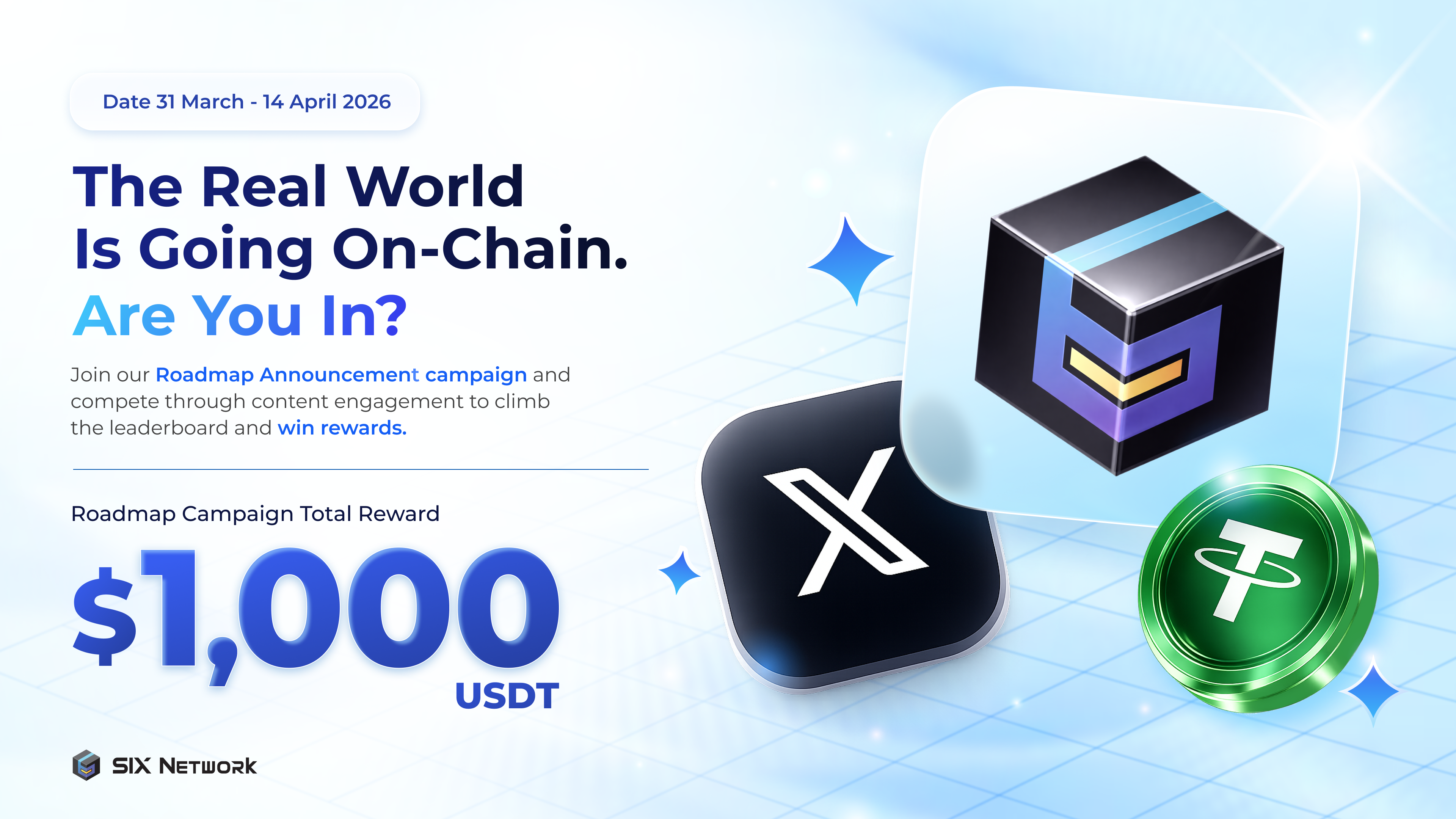
Celebrate the SIX Network Roadmap 2026 with our campaign 
Win a total of $1,000 USDT


The “SIX Network Roadmap 2026: Create & Claim Your Rewards” campaign was designed to connect the project’s long-term direction with real participation from users in the ecosystem. Turning the roadmap into something users can genuinely interact with significantly closes the gap between strategy and execution on the user activity side. The campaign format, combining engagement and incentive, serves as another mechanism to drive continuous activity within the ecosystem.


Join the Roadmap 2026 Campaign on X:  @theSIXNetwork 

Q1 Summary

Q1 was not only a period of planning and organization for the year ahead, it was also a time of identifying opportunities and positioning toward an enterprise-grade infrastructure role, forming new partnerships aligned with the AI direction, and building community engagement that points in the same direction. Q2 and the second half of the year will be the period where these structures begin to show results for everyone to see.


What’s Next

What SIX Network laid down in Q1 will start to show through in the second half of the year, clearer products, expanding partnerships, and enterprise use cases becoming more concrete. The focus remains on building a financial infrastructure layer capable of serving the global RWA market, and proving that the foundation now in place can perform at an institutional level.

⎯⎯⎯⎯⎯⎯⎯⎯⎯⎯⎯⎯⎯⎯⎯⎯⎯⎯⎯⎯⎯⎯⎯⎯⎯⎯⎯⎯⎯⎯⎯⎯

Disclaimer:

1.This article is intended for informational purposes only. Please conduct your own research before making any investment decisions related to cryptocurrencies 2. Cryptocurrency and digital token involve high risk; investors may lose all investment money and should study information carefully and make investments according to their own risk profile.


Don’t miss out follow us at:

Warisara Thepsiri
Warisara Thepsiri

Experience the magic of Blockchain with SIX Network!

Related Posts

SIX Network Q1 2026 Summary Building Blockchain Infrastructure Toward Institutional-Grade Financial Infrastructure

สรุปภาพรวม SIX Network ไตรมาส 1 ปี 2026

เริ่มพัฒนาโครงสร้างพื้นฐาน Blockchain สู่ Financial Infrastructure ระดับสถาบัน ตลาด RWA กำลังเข้าสู่จุดเปลี่ยนสำคัญ ไม่ใช่แค่การเติบโตในเชิงขนาด แต่รวมถึงการเข้ามาของผู้เล่นรายใหม่ ทั้งสถาบันการเงิน ผู้จัดการสินทรัพย์ และองค์กรระดับโลก ซึ่งพวกเขาไม่ได้มองหาแค่ blockchain แต่พวกเขากำลังมองหาโครงสร้างพื้นฐานที่รองรับความต้องการระดับสถาบันได้จริง ทำให้ในช่วงไตรมาส 1 ปี

Read More

Expanding SIX Network into the Global RWA Market

Expanding SIX Network into the Global RWA Market

Scale in the Global RWA Market

​​Building Visible Value with THB 2.49 Billion in TVL


As outlined in our 2026 roadmap, SIX Network is moving forward with a clear direction to expand the role of SIX Network and SIX Protocol into the global RWA market. This builds on our continuous development of tokenization technology, alongside strategic collaborations to support bringing real-world assets onto blockchain infrastructure.


Today, SIX Protocol holds approximately THB 2.49 billion in total value locked (TVL), reflecting early-stage real-world adoption at a level where the market can begin to recognize and evaluate its potential.


The growth of the RWA market signals that we are on the right path

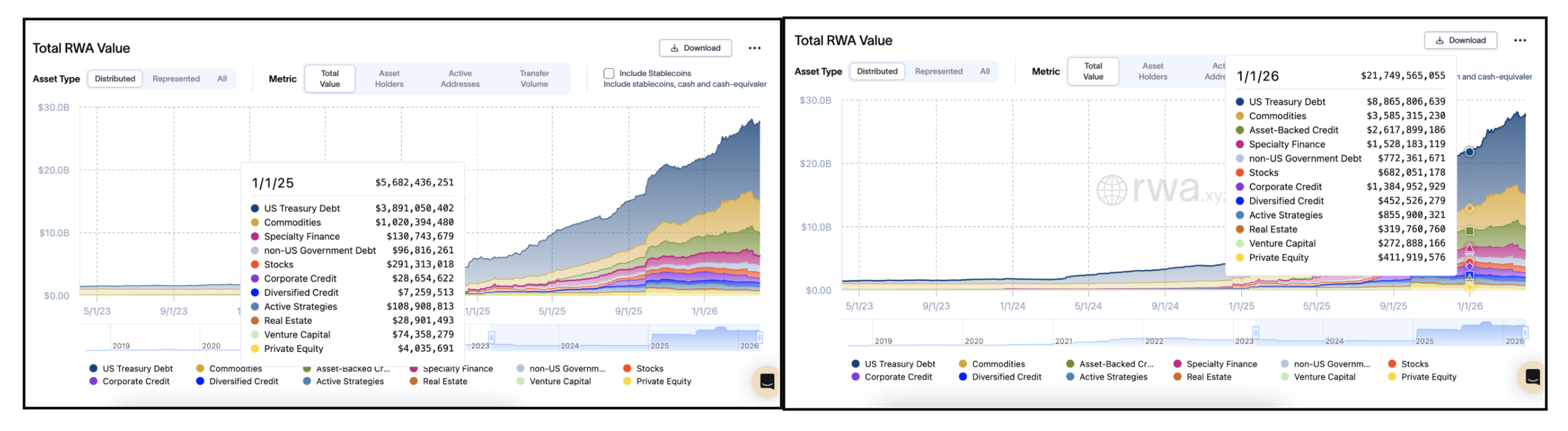
Growth of Total RWA Value on 1 Jan 2025 - 1 Jan 2026

Growth of Total RWA Value on 1 Jan 2025 – 1 Jan 2026


The chart above illustrates the growth of the RWA tokenization market based on data from RWA.xyz, a leading analytics platform tracking real-world asset tokenization.


Over the past few years, the market has experienced rapid expansion, reaching a total value of more than USD 26.89 billion and growing over fourfold within just one year.


This growth reflects increasing interest from both institutional players and a broader base of investors. More importantly, it signals a structural shift, where RWA tokenization is evolving into a key component of modern financial infrastructure, enabling the widespread integration of blockchain technology across real-world financial use cases.


This momentum is one of the key reasons SIX Network is expanding into the global RWA market, alongside continuously onboarding new asset types onto the protocol. The objective is not simply to increase on-chain asset value, but to focus on asset classes that are already trusted and understood globally, such as commodities, stablecoins, stocks, and other familiar financial instruments that institutional and global partners can easily recognize and adopt.


Currently, SIX Protocol supports over USD 90 million in on-chain assets, representing early traction in bringing real-world assets onto blockchain infrastructure. Based on this, the protocol has the potential to move toward the global Top 20 networks by total on-chain RWA value.


Expanding globally through ecosystem strength


The next phase of growth for SIX Protocol depends on its ability to develop on-chain assets that align with global market demand, while maintaining infrastructure that supports real-world enterprise use. When both asset quality and system design evolve together, they form the foundation for scalable global expansion.


At the same time, having assets that are recognized and trusted at a global level will strengthen confidence among investors and partners, driving growth across the broader ecosystem, not only at the protocol level, but also extending to SIX Token and Pas.ss as interconnected components of the network.


• Read the full SIX Network Roadmap 2026: Click

• Join our Roadmap 2026 campaign: Join Now


⎯⎯⎯⎯⎯⎯⎯⎯⎯⎯⎯⎯⎯⎯⎯⎯⎯⎯⎯⎯⎯⎯⎯⎯⎯⎯⎯⎯⎯⎯⎯⎯

Disclaimer:

1.This article is intended for informational purposes only. Please conduct your own research before making any investment decisions related to cryptocurrencies 2. Cryptocurrency and digital token involve high risk; investors may lose all investment money and should study information carefully and make investments according to their own risk profile.


Don’t miss out follow us at:

Warisara Thepsiri
Warisara Thepsiri

Experience the magic of Blockchain with SIX Network!

Related Posts

SIX Network Q1 2026 Summary Building Blockchain Infrastructure Toward Institutional-Grade Financial Infrastructure

สรุปภาพรวม SIX Network ไตรมาส 1 ปี 2026

เริ่มพัฒนาโครงสร้างพื้นฐาน Blockchain สู่ Financial Infrastructure ระดับสถาบัน ตลาด RWA กำลังเข้าสู่จุดเปลี่ยนสำคัญ ไม่ใช่แค่การเติบโตในเชิงขนาด แต่รวมถึงการเข้ามาของผู้เล่นรายใหม่ ทั้งสถาบันการเงิน ผู้จัดการสินทรัพย์ และองค์กรระดับโลก ซึ่งพวกเขาไม่ได้มองหาแค่ blockchain แต่พวกเขากำลังมองหาโครงสร้างพื้นฐานที่รองรับความต้องการระดับสถาบันได้จริง ทำให้ในช่วงไตรมาส 1 ปี

Read More

Series Blog 4: Operationalizing Regulatory Architecture

Series Blog 4: Operationalizing Regulatory Architecture

Series Blog 4 Operationalizing Regulatory Architecture with SIX Network

Understanding regulatory principles is only the first step. The more difficult challenge lies in operationalizing those principles within live systems.


Moving from compliance design to production deployment requires coordination between architecture, legal, operations, and security teams.


Embedding Compliance into Operational Workflows


Rather than treating compliance as a reporting function, mature architectures embed regulatory controls into transaction workflows.


Examples include:

• Multi-level approval processes before transaction finalization

• Automated logging of authorization events

• Clearly defined retention and archival policies

• Defined escalation paths for exceptional cases


These controls are implemented primarily in enterprise application logic and governance frameworks. Blockchain serves as a verifiable execution and recording layer.


SIX Garage and related tooling can assist in structuring asset management and permission workflows, but they operate within broader governance systems defined by the organization.


Monitoring and Continuous Oversight


Production systems require observability. Compliance does not end at deployment; it requires continuous oversight.


Architectural monitoring typically covers:

• Transaction latency and failure rates

• Role misuse or unauthorized access attempts

• Data consistency across on-chain and off-chain components

• Audit trail completeness


SIX Network infrastructure can be integrated into existing monitoring frameworks, allowing blockchain operations to be managed alongside other enterprise systems.


From Policy to Implementation


Regulatory frameworks such as GDPR, HIPAA, SOX, or AML/KYC define principles. Implementation varies by jurisdiction and organization.


No protocol can automatically guarantee compliance across all contexts. Instead, infrastructure should provide flexibility and traceability that enable organizations to implement their own compliance interpretations.


SIX Network’s approach emphasizes architectural support rather than automated regulatory guarantees.


Conclusion


Enterprise blockchain deployment in regulated environments requires architectural rigor, governance clarity, and operational discipline.


SIX Network’s standards-based protocol and supporting tools are designed to align with these enterprise requirements, not to replace them.


By approaching integration and compliance as architectural challenges rather than marketing features, organizations can move toward sustainable, production-ready blockchain adoption.

⎯⎯⎯⎯⎯⎯⎯⎯⎯⎯⎯⎯⎯⎯⎯⎯⎯⎯⎯⎯⎯⎯⎯⎯⎯⎯⎯⎯⎯⎯⎯⎯

Disclaimer:

1.This article is intended for informational purposes only. Please conduct your own research before making any investment decisions related to cryptocurrencies 2. Cryptocurrency and digital token involve high risk; investors may lose all investment money and should study information carefully and make investments according to their own risk profile.


Don’t miss out follow us at:

Warisara Thepsiri
Warisara Thepsiri

Experience the magic of Blockchain with SIX Network!

Related Posts

SIX Network Q1 2026 Summary Building Blockchain Infrastructure Toward Institutional-Grade Financial Infrastructure

สรุปภาพรวม SIX Network ไตรมาส 1 ปี 2026

เริ่มพัฒนาโครงสร้างพื้นฐาน Blockchain สู่ Financial Infrastructure ระดับสถาบัน ตลาด RWA กำลังเข้าสู่จุดเปลี่ยนสำคัญ ไม่ใช่แค่การเติบโตในเชิงขนาด แต่รวมถึงการเข้ามาของผู้เล่นรายใหม่ ทั้งสถาบันการเงิน ผู้จัดการสินทรัพย์ และองค์กรระดับโลก ซึ่งพวกเขาไม่ได้มองหาแค่ blockchain แต่พวกเขากำลังมองหาโครงสร้างพื้นฐานที่รองรับความต้องการระดับสถาบันได้จริง ทำให้ในช่วงไตรมาส 1 ปี

Read More

Series Blog 3: Designing Blockchain for Regulatory Alignment

Series Blog 3: Designing Blockchain for Regulatory Alignment

Series Blog 3 Designing Blockchain Systems for Regulatory Alignment

Enter to Blog 3: How Blockchain Architecture Can Be Built for Compliance and Regulatory


Compliance concerns often surface early in blockchain discussions. Questions about immutability, data protection, and auditability frequently delay adoption decisions.


However, many compliance challenges arise not from blockchain itself, but from incomplete architectural design. Regulatory alignment is rarely achieved through features alone. It requires deliberate system partitioning and governance modeling.


This article explores how compliance can be approached as an architectural principle rather than a reactive requirement.


Separation of On-Chain and Off-Chain Data

One of the most common misconceptions is that all operational data must reside on-chain. In regulated environments, this is rarely appropriate.


A structured architecture typically separates:

• Transaction proofs and hashes (on-chain)

• Sensitive or personal data (off-chain, within controlled databases)


Blockchain functions as an integrity and verification layer rather than a primary data repository.


SIX Protocol can support this model because it does not impose a rigid data storage architecture. Organizations retain flexibility in determining what information is recorded on-chain.


Permissioned Control and Identity Mapping


Regulatory frameworks often require clear attribution of actions. This means system architecture must map enterprise identity management systems to blockchain-level roles.


Permissioned models allow organizations to define who can initiate, approve, or view specific transactions. However, identity verification and access governance remain enterprise responsibilities.


SIX Protocol’s permission structures and traceable transaction metadata can support this alignment, but compliance ultimately depends on governance processes and audit design.


Auditability Without Overexposure


Another common concern involves transparency. Public blockchains expose transaction data broadly, which may conflict with confidentiality requirements.


Architectural strategies such as encryption, role-based access control, and metadata minimization allow organizations to maintain auditability without disclosing unnecessary information.


The objective is controlled transparency, providing regulators and auditors with verifiable records while limiting exposure of sensitive business data.


Complete Your Design Blockchain Systems 


Compliance should not be treated as a secondary checklist applied after system deployment. It must inform architectural decisions from the beginning.


SIX Protocol provides technical capabilities, permission models, traceability, and integration flexibility that can support compliance-oriented design. However, regulatory alignment is achieved through thoughtful system architecture and operational governance.


In the final article, we explore practical considerations for moving from compliance design principles to operational deployment.


────────────────────────────────────


Learn more about SIX Network

Website l Telegram l Twitter l Facebook l Discord l Medium

⎯⎯⎯⎯⎯⎯⎯⎯⎯⎯⎯⎯⎯⎯⎯⎯⎯⎯⎯⎯⎯⎯⎯⎯⎯⎯⎯⎯⎯⎯⎯⎯

Disclaimer:

1.This article is intended for informational purposes only. Please conduct your own research before making any investment decisions related to cryptocurrencies 2. Cryptocurrency and digital token involve high risk; investors may lose all investment money and should study information carefully and make investments according to their own risk profile.


Don’t miss out follow us at:

Warisara Thepsiri
Warisara Thepsiri

Experience the magic of Blockchain with SIX Network!

Related Posts

SIX Network Q1 2026 Summary Building Blockchain Infrastructure Toward Institutional-Grade Financial Infrastructure

สรุปภาพรวม SIX Network ไตรมาส 1 ปี 2026

เริ่มพัฒนาโครงสร้างพื้นฐาน Blockchain สู่ Financial Infrastructure ระดับสถาบัน ตลาด RWA กำลังเข้าสู่จุดเปลี่ยนสำคัญ ไม่ใช่แค่การเติบโตในเชิงขนาด แต่รวมถึงการเข้ามาของผู้เล่นรายใหม่ ทั้งสถาบันการเงิน ผู้จัดการสินทรัพย์ และองค์กรระดับโลก ซึ่งพวกเขาไม่ได้มองหาแค่ blockchain แต่พวกเขากำลังมองหาโครงสร้างพื้นฐานที่รองรับความต้องการระดับสถาบันได้จริง ทำให้ในช่วงไตรมาส 1 ปี

Read More

Series Blog 2: Architectural Integration Patterns with SIX Network

Series Blog 2: Architectural Integration Patterns with SIX Network

Series Blog2: Architectural Integration Patterns with SIX Network

Enter to Blog 2: Architectural Integration Patterns with SIX Network


In the previous article, we discussed how standards alignment, particularly EVM compatibility, reduces friction during enterprise blockchain adoption. However, compatibility alone does not solve integration complexity. What determines long-term success is architectural discipline.


Enterprise blockchain integration should not be treated as a feature implementation. It is an architectural extension of the existing system landscape. Without clear boundaries and integration patterns, blockchain components risk becoming tightly coupled to core systems, increasing operational risk and long-term maintenance cost.


This article examines architectural integration approaches that can be applied when working with SIX Protocol.


The Adapter Layer as an Architectural Boundary


One of the most reliable integration strategies in enterprise environments is the introduction of an adapter or middleware layer between core systems and blockchain infrastructure.


Instead of allowing ERP or CRM systems to directly interact with smart contracts, a controlled integration layer handles:

• Data transformation

• Transaction creation

• Signing and authorization

• Error handling and retry logic


This separation ensures that blockchain-specific concerns remain isolated. Core enterprise systems continue operating using their existing data models and workflows.

SIX Protocol’s standards-based execution environment allows this boundary to be implemented without proprietary constraints. Because it follows EVM standards, integration layers can leverage widely available libraries and established development patterns.


The objective is not simplification through abstraction alone, but architectural containment. Blockchain logic becomes a replaceable or evolvable component rather than a deeply embedded dependency.


Event-Driven Recording Without System Disruption


Many enterprise systems already rely on event-driven architectures. In such environments, blockchain should function as a recording or verification layer triggered by specific business events, rather than as the primary transaction processor.


For example, when an order is finalized or a compliance approval is completed, an event can be emitted internally. A blockchain integration service listens to these events and records relevant transaction metadata onchain.


This approach provides traceability without requiring the core business system to be redesigned. It also reduces operational risk, as business continuity does not depend on blockchain availability.


SIX Protocol supports this model because it does not require tightly coupled execution patterns. It can function as an external integrity layer that complements existing workflows.


Designing for Governance and Observability


Enterprise architects must consider governance and monitoring from the beginning. Blockchain components should integrate into existing operational monitoring frameworks rather than exist as isolated infrastructure.


Key architectural considerations typically include:

• How transaction states are monitored

• How failures are surfaced to operations teams

• How audit logs are correlated across systems

• How identity and permission models map between enterprise systems and blockchain roles


SIX Protocol’s permission capabilities and transaction traceability can support governance design, but they do not replace it. Governance remains an architectural responsibility.


Key Takeaway

Successful blockchain integration is less about adding distributed infrastructure and more about disciplined system design. Adapter layers, event-driven recording, and governance mapping are architectural tools, not product features.


SIX Network’s design choices allow these architectural strategies to be applied without introducing proprietary execution models or isolated tooling stacks.


In the next article, we shift focus from integration patterns to regulatory architecture and compliance-oriented design.


────────────────────────────────────

Learn more about SIX Network

Website l Telegram l Twitter l Facebook l Discord l Medium

⎯⎯⎯⎯⎯⎯⎯⎯⎯⎯⎯⎯⎯⎯⎯⎯⎯⎯⎯⎯⎯⎯⎯⎯⎯⎯⎯⎯⎯⎯⎯⎯

Disclaimer:

1.This article is intended for informational purposes only. Please conduct your own research before making any investment decisions related to cryptocurrencies 2. Cryptocurrency and digital token involve high risk; investors may lose all investment money and should study information carefully and make investments according to their own risk profile.


Don’t miss out follow us at:

Warisara Thepsiri
Warisara Thepsiri

Experience the magic of Blockchain with SIX Network!

Related Posts

SIX Network Q1 2026 Summary Building Blockchain Infrastructure Toward Institutional-Grade Financial Infrastructure

สรุปภาพรวม SIX Network ไตรมาส 1 ปี 2026

เริ่มพัฒนาโครงสร้างพื้นฐาน Blockchain สู่ Financial Infrastructure ระดับสถาบัน ตลาด RWA กำลังเข้าสู่จุดเปลี่ยนสำคัญ ไม่ใช่แค่การเติบโตในเชิงขนาด แต่รวมถึงการเข้ามาของผู้เล่นรายใหม่ ทั้งสถาบันการเงิน ผู้จัดการสินทรัพย์ และองค์กรระดับโลก ซึ่งพวกเขาไม่ได้มองหาแค่ blockchain แต่พวกเขากำลังมองหาโครงสร้างพื้นฐานที่รองรับความต้องการระดับสถาบันได้จริง ทำให้ในช่วงไตรมาส 1 ปี

Read More

Introduce Series: How SIX Network Approaches Enterprise Integration and Compliance

Introduce Series: How SIX Network Approaches Enterprise Integration and Compliance

Introduce Series: How SIX Network Approaches Enterprise Integration and Compliance Blog 1

Enterprise blockchain adoption often slows down not because of the technology itself, but because of integration complexity and regulatory considerations. This four-part blog series explores how SIX Network approaches these challenges from an architectural perspective.


Blog 1 examines how SIX Protocol’s EVM compatibility supports structured integration with existing enterprise systems and reduces architectural fragmentation.

Blog 2 explores practical integration patterns, such as adapter layers and event-driven models, that help organizations incorporate blockchain without tightly coupling core systems.

Blog 3 focuses on regulatory alignment, discussing how permission models, traceability, and system design can support compliance-oriented architecture.

Blog 4 looks at operationalization, covering governance, monitoring, and how compliance principles translate into production environments.


Throughout this series, we focus on architectural alignment, governance clarity, and standards-based design as foundations for sustainable enterprise blockchain adoption.


Blog 1

Overcoming Integration Complexity
Part 1: How SIX Protocol Supports Structured Enterprise Blockchain Integration

Enterprise blockchain integration is often perceived as complex and high-risk. In practice, the challenge rarely lies in blockchain technology alone. Instead, complexity arises from how blockchain systems interact with existing enterprise infrastructure, ERP platforms, CRM systems, identity frameworks, data governance models, and regulatory controls.


Many organizations successfully build proof-of-concept projects, but transitioning from pilot to production introduces architectural, operational, and compliance considerations that require structured planning.


SIX Protocol v4.0 was developed with these realities in mind. Rather than introducing a proprietary execution model, SIX Protocol aligns with established industry standards, particularly EVM compatibility. This architectural decision supports integration planning that is more predictable and aligned with existing development ecosystems.


This article is the first in a four-part series exploring how SIX Network approaches integration complexity and regulatory requirements in enterprise environments.


The Practical Role of EVM Compatibility

A common friction point in enterprise adoption is the introduction of new programming languages, tooling stacks, or execution environments. When platforms require proprietary development models, organizations must retrain teams or recruit new talent.


SIX Protocol supports the Ethereum Virtual Machine (EVM) at the core protocol level. Developers can write smart contracts in Solidity and use established development tools such as Hardhat and Truffle. This does not automatically shorten project timelines, but it reduces uncertainty by leveraging a mature ecosystem.


By aligning with widely adopted standards, organizations can reuse existing internal knowledge and external expertise. The decision to support EVM is therefore less about performance marketing and more about minimizing architectural fragmentation.


Supporting Enterprise Workflows Through the SIX Ecosystem

Beyond the protocol layer, SIX Network provides tools that support digital asset implementation.


SIX Garage offers capabilities for issuing and managing digital assets, including token configuration, permission management, and administrative oversight. These functions are designed to assist organizations that require structured governance over digital asset lifecycles.


Pas.ss provides a framework for managing digital privileges and engagement use cases. It integrates with non-custodial wallet models, allowing organizations to implement user-facing digital programs without requiring centralized custody structures.


These tools are not substitutes for enterprise system design. Rather, they serve as building blocks that organizations can integrate into broader digital strategies.


Integration as an Architectural Exercise

Effective enterprise blockchain integration requires separation of concerns. Business logic should remain independent from blockchain execution logic wherever possible. Middleware layers or API gateways can mediate communication between core enterprise systems and blockchain components.


SIX Protocol’s standards-based architecture allows such layering without requiring proprietary infrastructure dependencies. This enables organizations to define clear boundaries between existing systems and blockchain components.


Integration planning should typically include:

• Data flow analysis

• Identity and access control mapping

• Transaction approval workflows

• Monitoring and operational oversight

• Pre-production validation


SIX Network’s design approach supports these structured planning processes rather than replacing them.


Summary

Enterprise blockchain adoption becomes manageable when architectural alignment, governance considerations, and ecosystem compatibility are addressed early.


SIX Protocol’s EVM compatibility and the broader SIX ecosystem are designed to support structured integration planning rather than shortcut it. By relying on established standards and modular tooling, organizations can reduce integration uncertainty and build toward sustainable deployment models.


In the next article, we will examine practical integration patterns that can be applied within enterprise environments using SIX Network infrastructure.

────────────────────────────────────

Learn more about SIX Network

Website l Telegram l Twitter l Facebook l Discord l Medium

⎯⎯⎯⎯⎯⎯⎯⎯⎯⎯⎯⎯⎯⎯⎯⎯⎯⎯⎯⎯⎯⎯⎯⎯⎯⎯⎯⎯⎯⎯⎯⎯

Disclaimer:

1.This article is intended for informational purposes only. Please conduct your own research before making any investment decisions related to cryptocurrencies 2. Cryptocurrency and digital token involve high risk; investors may lose all investment money and should study information carefully and make investments according to their own risk profile.


Don’t miss out follow us at:

Warisara Thepsiri
Warisara Thepsiri

Experience the magic of Blockchain with SIX Network!

Related Posts

SIX Network Q1 2026 Summary Building Blockchain Infrastructure Toward Institutional-Grade Financial Infrastructure

สรุปภาพรวม SIX Network ไตรมาส 1 ปี 2026

เริ่มพัฒนาโครงสร้างพื้นฐาน Blockchain สู่ Financial Infrastructure ระดับสถาบัน ตลาด RWA กำลังเข้าสู่จุดเปลี่ยนสำคัญ ไม่ใช่แค่การเติบโตในเชิงขนาด แต่รวมถึงการเข้ามาของผู้เล่นรายใหม่ ทั้งสถาบันการเงิน ผู้จัดการสินทรัพย์ และองค์กรระดับโลก ซึ่งพวกเขาไม่ได้มองหาแค่ blockchain แต่พวกเขากำลังมองหาโครงสร้างพื้นฐานที่รองรับความต้องการระดับสถาบันได้จริง ทำให้ในช่วงไตรมาส 1 ปี

Read More