fbpx

Series Blog 3: Designing Blockchain for Regulatory Alignment

Series Blog 3: Designing Blockchain for Regulatory Alignment

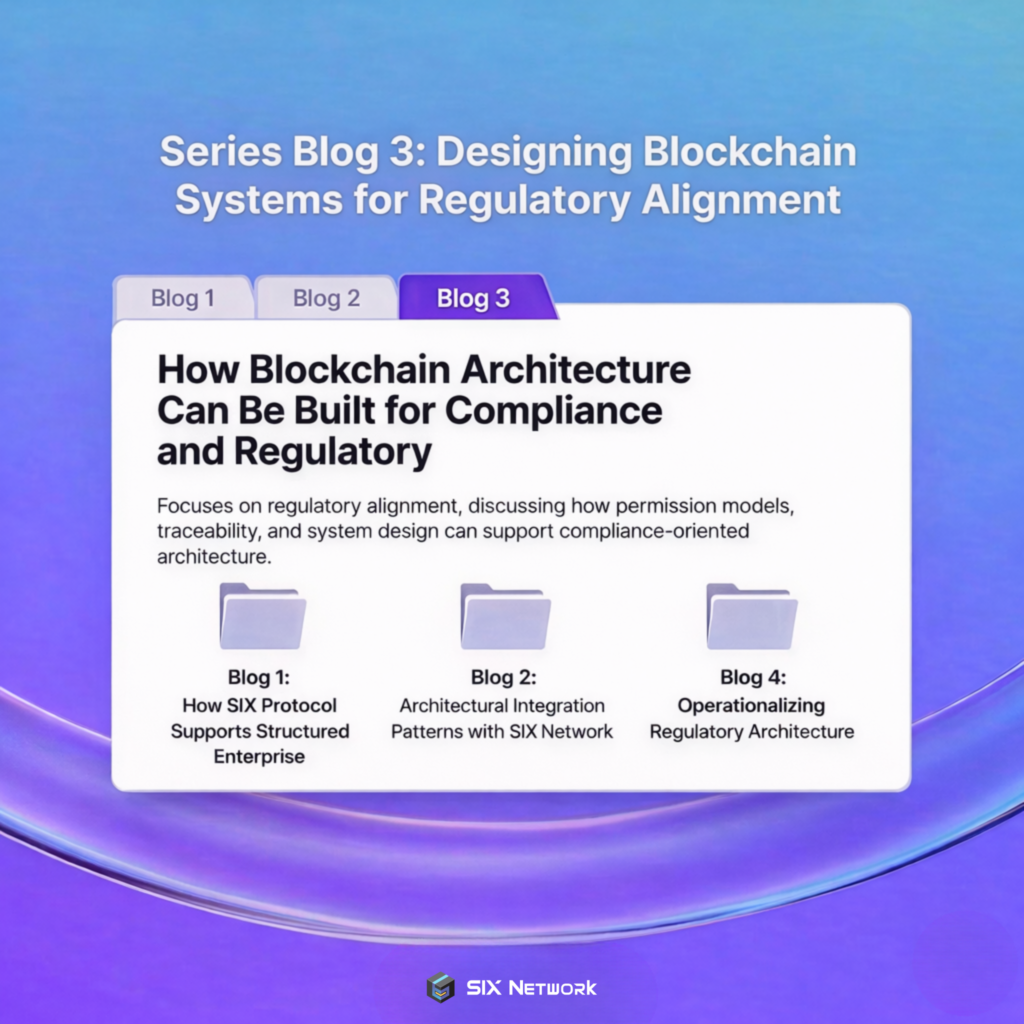
Series Blog 3 Designing Blockchain Systems for Regulatory Alignment

Enter to Blog 3: How Blockchain Architecture Can Be Built for Compliance and Regulatory


Compliance concerns often surface early in blockchain discussions. Questions about immutability, data protection, and auditability frequently delay adoption decisions.


However, many compliance challenges arise not from blockchain itself, but from incomplete architectural design. Regulatory alignment is rarely achieved through features alone. It requires deliberate system partitioning and governance modeling.


This article explores how compliance can be approached as an architectural principle rather than a reactive requirement.


Separation of On-Chain and Off-Chain Data

One of the most common misconceptions is that all operational data must reside on-chain. In regulated environments, this is rarely appropriate.


A structured architecture typically separates:

• Transaction proofs and hashes (on-chain)

• Sensitive or personal data (off-chain, within controlled databases)


Blockchain functions as an integrity and verification layer rather than a primary data repository.


SIX Protocol can support this model because it does not impose a rigid data storage architecture. Organizations retain flexibility in determining what information is recorded on-chain.


Permissioned Control and Identity Mapping


Regulatory frameworks often require clear attribution of actions. This means system architecture must map enterprise identity management systems to blockchain-level roles.


Permissioned models allow organizations to define who can initiate, approve, or view specific transactions. However, identity verification and access governance remain enterprise responsibilities.


SIX Protocol’s permission structures and traceable transaction metadata can support this alignment, but compliance ultimately depends on governance processes and audit design.


Auditability Without Overexposure


Another common concern involves transparency. Public blockchains expose transaction data broadly, which may conflict with confidentiality requirements.


Architectural strategies such as encryption, role-based access control, and metadata minimization allow organizations to maintain auditability without disclosing unnecessary information.


The objective is controlled transparency, providing regulators and auditors with verifiable records while limiting exposure of sensitive business data.


Complete Your Design Blockchain Systems 


Compliance should not be treated as a secondary checklist applied after system deployment. It must inform architectural decisions from the beginning.


SIX Protocol provides technical capabilities, permission models, traceability, and integration flexibility that can support compliance-oriented design. However, regulatory alignment is achieved through thoughtful system architecture and operational governance.


In the final article, we explore practical considerations for moving from compliance design principles to operational deployment.


────────────────────────────────────


Learn more about SIX Network

Website l Telegram l Twitter l Facebook l Discord l Medium

⎯⎯⎯⎯⎯⎯⎯⎯⎯⎯⎯⎯⎯⎯⎯⎯⎯⎯⎯⎯⎯⎯⎯⎯⎯⎯⎯⎯⎯⎯⎯⎯

Disclaimer:

1.This article is intended for informational purposes only. Please conduct your own research before making any investment decisions related to cryptocurrencies 2. Cryptocurrency and digital token involve high risk; investors may lose all investment money and should study information carefully and make investments according to their own risk profile.


Don’t miss out follow us at:

Warisara Thepsiri
Warisara Thepsiri

Experience the magic of Blockchain with SIX Network!

Related Posts

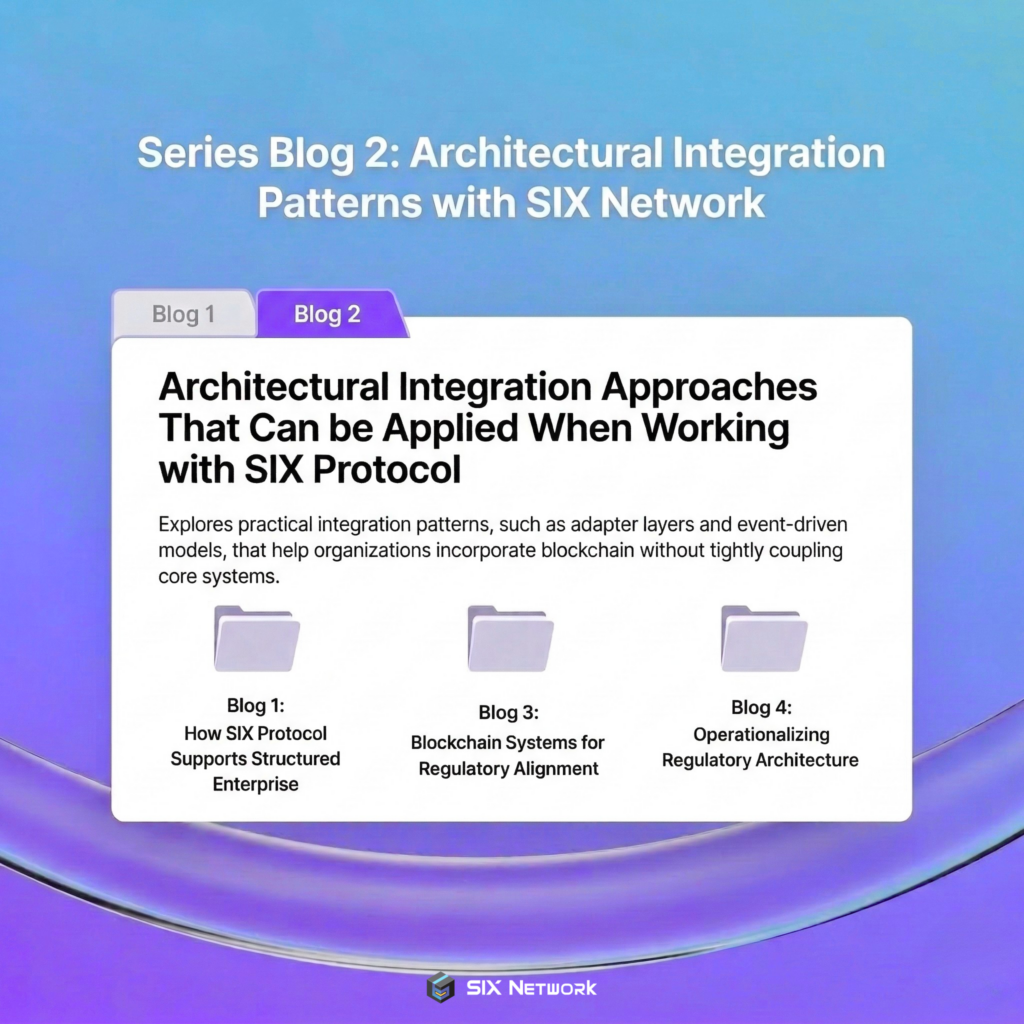
Series Blog 2: Architectural Integration Patterns with SIX Network

Series Blog 2: Architectural Integration Patterns with SIX Network

Series Blog2: Architectural Integration Patterns with SIX Network

Enter to Blog 2: Architectural Integration Patterns with SIX Network


In the previous article, we discussed how standards alignment, particularly EVM compatibility, reduces friction during enterprise blockchain adoption. However, compatibility alone does not solve integration complexity. What determines long-term success is architectural discipline.


Enterprise blockchain integration should not be treated as a feature implementation. It is an architectural extension of the existing system landscape. Without clear boundaries and integration patterns, blockchain components risk becoming tightly coupled to core systems, increasing operational risk and long-term maintenance cost.


This article examines architectural integration approaches that can be applied when working with SIX Protocol.


The Adapter Layer as an Architectural Boundary


One of the most reliable integration strategies in enterprise environments is the introduction of an adapter or middleware layer between core systems and blockchain infrastructure.


Instead of allowing ERP or CRM systems to directly interact with smart contracts, a controlled integration layer handles:

• Data transformation

• Transaction creation

• Signing and authorization

• Error handling and retry logic


This separation ensures that blockchain-specific concerns remain isolated. Core enterprise systems continue operating using their existing data models and workflows.

SIX Protocol’s standards-based execution environment allows this boundary to be implemented without proprietary constraints. Because it follows EVM standards, integration layers can leverage widely available libraries and established development patterns.


The objective is not simplification through abstraction alone, but architectural containment. Blockchain logic becomes a replaceable or evolvable component rather than a deeply embedded dependency.


Event-Driven Recording Without System Disruption


Many enterprise systems already rely on event-driven architectures. In such environments, blockchain should function as a recording or verification layer triggered by specific business events, rather than as the primary transaction processor.


For example, when an order is finalized or a compliance approval is completed, an event can be emitted internally. A blockchain integration service listens to these events and records relevant transaction metadata onchain.


This approach provides traceability without requiring the core business system to be redesigned. It also reduces operational risk, as business continuity does not depend on blockchain availability.


SIX Protocol supports this model because it does not require tightly coupled execution patterns. It can function as an external integrity layer that complements existing workflows.


Designing for Governance and Observability


Enterprise architects must consider governance and monitoring from the beginning. Blockchain components should integrate into existing operational monitoring frameworks rather than exist as isolated infrastructure.


Key architectural considerations typically include:

• How transaction states are monitored

• How failures are surfaced to operations teams

• How audit logs are correlated across systems

• How identity and permission models map between enterprise systems and blockchain roles


SIX Protocol’s permission capabilities and transaction traceability can support governance design, but they do not replace it. Governance remains an architectural responsibility.


Key Takeaway

Successful blockchain integration is less about adding distributed infrastructure and more about disciplined system design. Adapter layers, event-driven recording, and governance mapping are architectural tools, not product features.


SIX Network’s design choices allow these architectural strategies to be applied without introducing proprietary execution models or isolated tooling stacks.


In the next article, we shift focus from integration patterns to regulatory architecture and compliance-oriented design.


────────────────────────────────────

Learn more about SIX Network

Website l Telegram l Twitter l Facebook l Discord l Medium

⎯⎯⎯⎯⎯⎯⎯⎯⎯⎯⎯⎯⎯⎯⎯⎯⎯⎯⎯⎯⎯⎯⎯⎯⎯⎯⎯⎯⎯⎯⎯⎯

Disclaimer:

1.This article is intended for informational purposes only. Please conduct your own research before making any investment decisions related to cryptocurrencies 2. Cryptocurrency and digital token involve high risk; investors may lose all investment money and should study information carefully and make investments according to their own risk profile.


Don’t miss out follow us at:

Warisara Thepsiri
Warisara Thepsiri

Experience the magic of Blockchain with SIX Network!

Related Posts

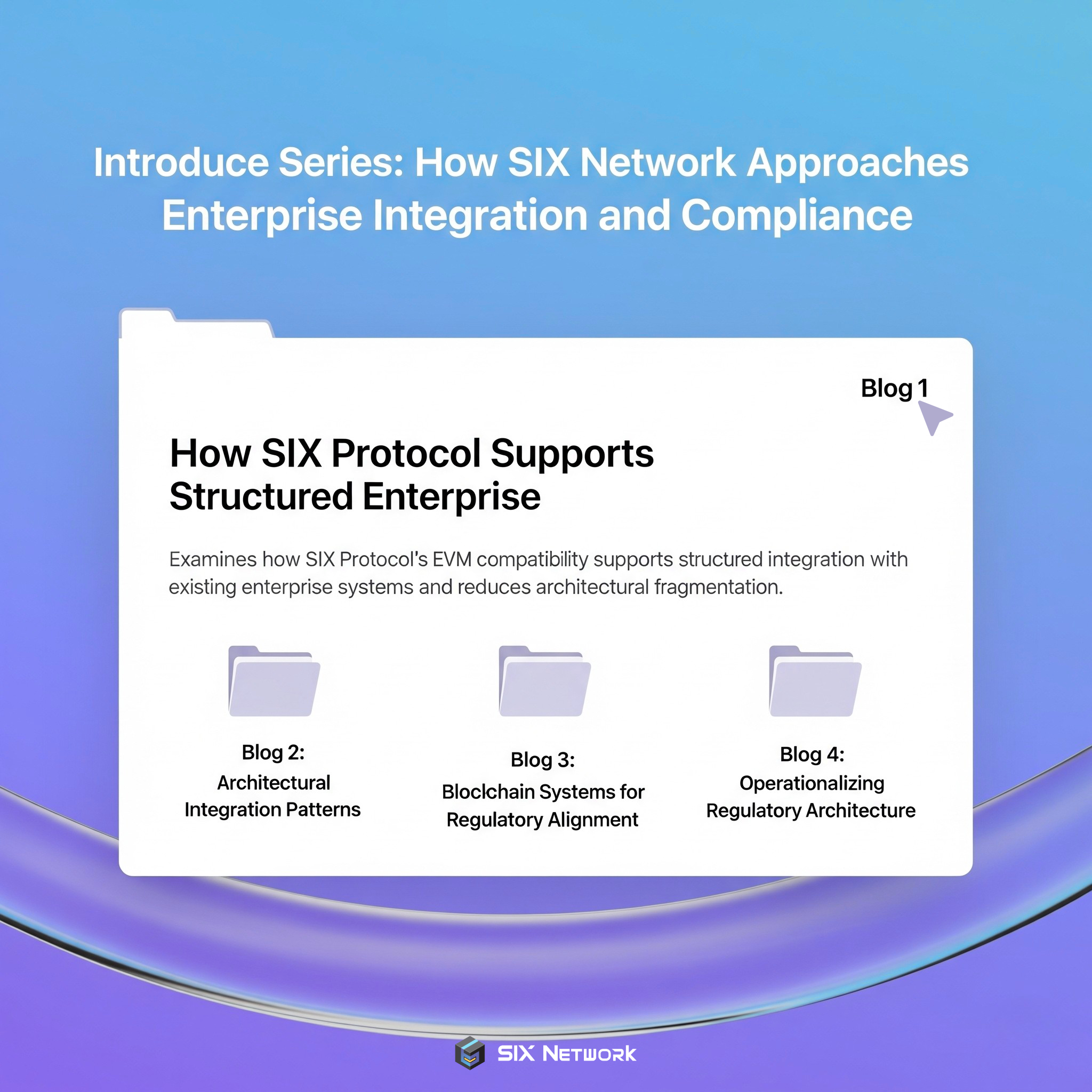
Introduce Series: How SIX Network Approaches Enterprise Integration and Compliance

Introduce Series: How SIX Network Approaches Enterprise Integration and Compliance

Introduce Series: How SIX Network Approaches Enterprise Integration and Compliance Blog 1

Enterprise blockchain adoption often slows down not because of the technology itself, but because of integration complexity and regulatory considerations. This four-part blog series explores how SIX Network approaches these challenges from an architectural perspective.


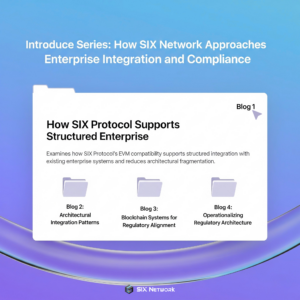
Blog 1 examines how SIX Protocol’s EVM compatibility supports structured integration with existing enterprise systems and reduces architectural fragmentation.

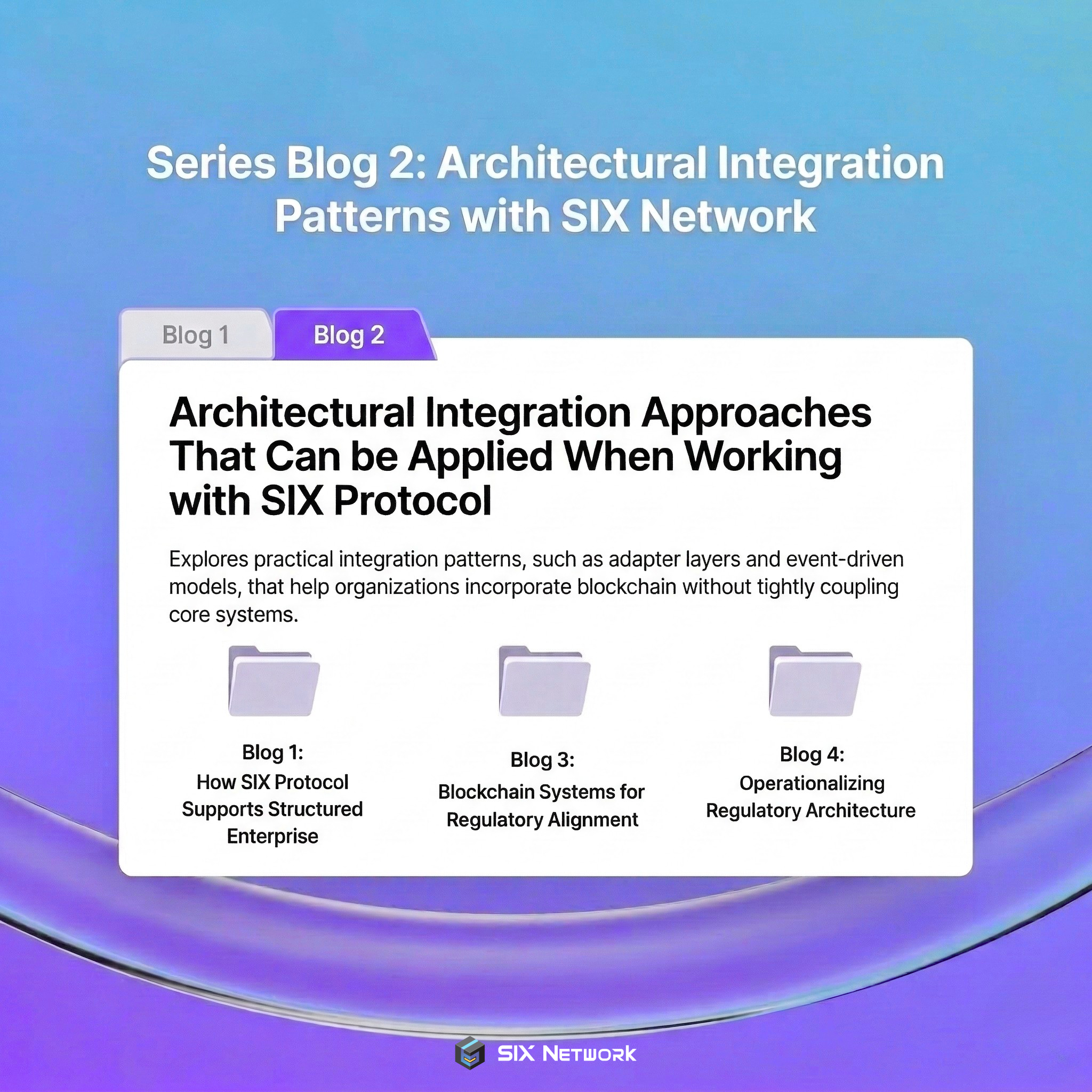
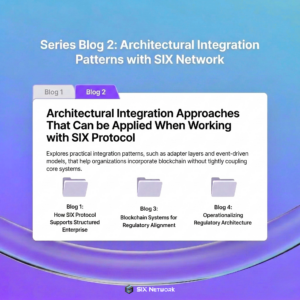
Blog 2 explores practical integration patterns, such as adapter layers and event-driven models, that help organizations incorporate blockchain without tightly coupling core systems.

Blog 3 focuses on regulatory alignment, discussing how permission models, traceability, and system design can support compliance-oriented architecture.

Blog 4 looks at operationalization, covering governance, monitoring, and how compliance principles translate into production environments.


Throughout this series, we focus on architectural alignment, governance clarity, and standards-based design as foundations for sustainable enterprise blockchain adoption.


Blog 1

Overcoming Integration Complexity
Part 1: How SIX Protocol Supports Structured Enterprise Blockchain Integration

Enterprise blockchain integration is often perceived as complex and high-risk. In practice, the challenge rarely lies in blockchain technology alone. Instead, complexity arises from how blockchain systems interact with existing enterprise infrastructure, ERP platforms, CRM systems, identity frameworks, data governance models, and regulatory controls.


Many organizations successfully build proof-of-concept projects, but transitioning from pilot to production introduces architectural, operational, and compliance considerations that require structured planning.


SIX Protocol v4.0 was developed with these realities in mind. Rather than introducing a proprietary execution model, SIX Protocol aligns with established industry standards, particularly EVM compatibility. This architectural decision supports integration planning that is more predictable and aligned with existing development ecosystems.


This article is the first in a four-part series exploring how SIX Network approaches integration complexity and regulatory requirements in enterprise environments.


The Practical Role of EVM Compatibility

A common friction point in enterprise adoption is the introduction of new programming languages, tooling stacks, or execution environments. When platforms require proprietary development models, organizations must retrain teams or recruit new talent.


SIX Protocol supports the Ethereum Virtual Machine (EVM) at the core protocol level. Developers can write smart contracts in Solidity and use established development tools such as Hardhat and Truffle. This does not automatically shorten project timelines, but it reduces uncertainty by leveraging a mature ecosystem.


By aligning with widely adopted standards, organizations can reuse existing internal knowledge and external expertise. The decision to support EVM is therefore less about performance marketing and more about minimizing architectural fragmentation.


Supporting Enterprise Workflows Through the SIX Ecosystem

Beyond the protocol layer, SIX Network provides tools that support digital asset implementation.


SIX Garage offers capabilities for issuing and managing digital assets, including token configuration, permission management, and administrative oversight. These functions are designed to assist organizations that require structured governance over digital asset lifecycles.


Pas.ss provides a framework for managing digital privileges and engagement use cases. It integrates with non-custodial wallet models, allowing organizations to implement user-facing digital programs without requiring centralized custody structures.


These tools are not substitutes for enterprise system design. Rather, they serve as building blocks that organizations can integrate into broader digital strategies.


Integration as an Architectural Exercise

Effective enterprise blockchain integration requires separation of concerns. Business logic should remain independent from blockchain execution logic wherever possible. Middleware layers or API gateways can mediate communication between core enterprise systems and blockchain components.


SIX Protocol’s standards-based architecture allows such layering without requiring proprietary infrastructure dependencies. This enables organizations to define clear boundaries between existing systems and blockchain components.


Integration planning should typically include:

• Data flow analysis

• Identity and access control mapping

• Transaction approval workflows

• Monitoring and operational oversight

• Pre-production validation


SIX Network’s design approach supports these structured planning processes rather than replacing them.


Summary

Enterprise blockchain adoption becomes manageable when architectural alignment, governance considerations, and ecosystem compatibility are addressed early.


SIX Protocol’s EVM compatibility and the broader SIX ecosystem are designed to support structured integration planning rather than shortcut it. By relying on established standards and modular tooling, organizations can reduce integration uncertainty and build toward sustainable deployment models.


In the next article, we will examine practical integration patterns that can be applied within enterprise environments using SIX Network infrastructure.

────────────────────────────────────

Learn more about SIX Network

Website l Telegram l Twitter l Facebook l Discord l Medium

⎯⎯⎯⎯⎯⎯⎯⎯⎯⎯⎯⎯⎯⎯⎯⎯⎯⎯⎯⎯⎯⎯⎯⎯⎯⎯⎯⎯⎯⎯⎯⎯

Disclaimer:

1.This article is intended for informational purposes only. Please conduct your own research before making any investment decisions related to cryptocurrencies 2. Cryptocurrency and digital token involve high risk; investors may lose all investment money and should study information carefully and make investments according to their own risk profile.


Don’t miss out follow us at:

Warisara Thepsiri
Warisara Thepsiri

Experience the magic of Blockchain with SIX Network!

Related Posts

SIX Protocol Enterprise-Grade Infrastructure

SIX Protocol Enterprise-Grade Infrastructure

SIX Protocol Enterprise-Grade Infrastructure

Understanding Enterprise-Grade Infrastructure for Tokenized Assets with SIX Protocol v4.0

The market for digital assets backed by real-world value continues to expand across sectors such as government bonds, real estate, and commodities. However, market growth does not automatically translate into enterprise readiness.


For organizations, the key question is not what blockchain can do in theory, but what kind of infrastructure is appropriate for mission-critical systems, especially when security, regulatory oversight, and operational stability are involved.


🔎📖  This article explores what enterprise-grade infrastructure means in the context of tokenized assets and how SIX Protocol v4.0 is designed to support these requirements from an architectural perspective.


The Enterprise Challenge

Blockchains designed primarily for general-purpose or public experimentation may not be sufficient for high-value, regulated asset environments.


Real estate tokenization may require structured ownership models, access controls, and traceable approvals across jurisdictions. Commodity trading systems often demand transaction finality within predictable timeframes. Digital securities require auditability, investor protection mechanisms, and alignment with reporting standards.


If the underlying infrastructure cannot support these design considerations, organizations may encounter delayed settlement, unclear access control boundaries, or limited audit transparency. Over time, these constraints affect institutional confidence and long-term scalability.


Enterprise-grade infrastructure must therefore prioritize stability, governance capability, and architectural clarity, not performance alone.


SIX Protocol v4.0 in the Enterprise Context
Get to Know SIX Protocol v4.0 with EVM Compatibility Based on the Ethereum Standard For Long-Term Business Development and Blockchain Expansion


SIX Protocol v4.0 was developed with enterprise tokenized asset environments in mind, particularly where real-world asset representation intersects with regulatory and operational requirements.


At the architectural level, the protocol supports EVM compatibility. This allows development teams to leverage established Ethereum tooling and standards, reducing dependency on proprietary execution environments. The intent is not simply familiarity, but architectural alignment with a widely adopted ecosystem.


The protocol operates using a Proof of Authority-based validator model, where validator nodes are managed within a structured network. This model supports predictable transaction validation and controlled governance, characteristics often required in institutional environments.


Rather than maximizing decentralization at all costs, the design balances performance, accountability, and operational reliability.


🔗 Learn more about SIX Protocol v4.0 
SIX Protocol v4.0 EVM Compatibility Based on the Ethereum Standard


Architecture Designed for Scalable Operations

SIX Protocol v4.0 uses a validator network operated under defined governance structures. This configuration reduces operational uncertainty and enables service-level considerations more aligned with enterprise expectations.


Transactions are grouped, validated, and finalized within short timeframes. For organizations handling asset transfers or financial workflows, reduced settlement latency contributes to improved capital efficiency and operational predictability.


The protocol also supports transaction traceability and structured data recording. Sensitive business or personal data does not need to reside fully on-chain. Instead, organizations can implement hybrid architectures where blockchain functions as an integrity and verification layer.


This architectural flexibility allows enterprises to design systems that align with data protection and internal governance policies.


Performance and Scalability

SIX Protocol is capable of processing transactions at a scale suitable for enterprise-level workloads under controlled network conditions. Transaction finality occurs within short intervals, supporting applications that require operational responsiveness.


Performance characteristics are influenced by network configuration and validator distribution, but the protocol is structured to support growing transaction volumes as enterprise adoption expands.


Fee structures are designed to remain stable and predictable relative to many public networks. For organizations managing large transaction volumes, cost predictability can be as important as raw throughput.


Security and Regulatory Alignment

At the application layer, SIX Protocol supports role-based access control, multi-signature authorization, and configurable transaction workflows. These capabilities allow organizations to embed internal approval processes directly into smart contract logic.

The protocol can integrate with external identity verification systems and supports transaction traceability required for compliance-oriented system design. In certain implementations, controlled transaction reversibility mechanisms can be configured to address specific legal or operational requirements.

However, regulatory compliance ultimately depends on organizational governance, policy design, and operational processes. Infrastructure can enable compliance-oriented architecture, but it does not replace regulatory responsibility.


Real-World Deployment Context

SIX Protocol has been used in digital real estate asset issuance scenarios requiring structured ownership and permission management.

In healthcare-related contexts, blockchain has functioned as a verification layer while sensitive patient data remains stored within secure internal systems. This hybrid model reflects a broader enterprise pattern: blockchain complements, rather than replaces, core systems.

These examples illustrate practical deployment models rather than theoretical capabilities.


Ongoing Development Direction

SIX Network continues to evolve its protocol with attention to privacy enhancements, cross-network interoperability, and scalability improvements.


Future development initiatives focus on strengthening architectural flexibility while maintaining governance clarity. Technologies such as advanced privacy techniques and network optimization mechanisms are under evaluation to support long-term enterprise use cases.


Conclusion

Enterprise-grade infrastructure for tokenized assets requires more than transaction speed. It must support governance structures, controlled access, traceability, and sustainable operational design.


SIX Protocol v4.0 reflects these considerations through standards alignment, a structured validator model, and supporting tools such as SIX Garage and Pas.ss that assist in digital asset lifecycle management.


For organizations evaluating blockchain infrastructure, architectural alignment, governance compatibility, and operational stability should weigh more heavily than performance claims alone.


SIX Network’s approach centers on supporting structured, responsible enterprise adoption rather than positioning blockchain as a standalone solution.

────────────────────────────────────

Learn more about SIX Network

Website l Telegram l Twitter l Facebook l Discord l Medium

⎯⎯⎯⎯⎯⎯⎯⎯⎯⎯⎯⎯⎯⎯⎯⎯⎯⎯⎯⎯⎯⎯⎯⎯⎯⎯⎯⎯⎯⎯⎯⎯

Disclaimer:

1.This article is intended for informational purposes only. Please conduct your own research before making any investment decisions related to cryptocurrencies 2. Cryptocurrency and digital token involve high risk; investors may lose all investment money and should study information carefully and make investments according to their own risk profile.


Don’t miss out follow us at:

Warisara Thepsiri
Warisara Thepsiri

Experience the magic of Blockchain with SIX Network!

Related Posts

SIX Protocol v4.0 EVM Compatibility Based on the Ethereum Standard

SIX Protocol v4.0 EVM Compatibility Based on the Ethereum Standard

Get to Know SIX Protocol v4.0 with EVM Compatibility Based on the Ethereum Standard For Long-Term Business Development and Blockchain Expansion

For Long Term Business Development and Blockchain Expansion

Many businesses are beginning to view blockchain as a foundational infrastructure for the future. This includes digital assets, payment systems, token issuance, and data management that requires transparency.


The key question is which network an organization should choose to support long term growth and connect smoothly with existing systems.


SIX Protocol v4.0 is developed with Full Native EVM Compatibility. This allows organizations to adapt their existing systems, teams, and expertise to blockchain more easily, while supporting business level scalability.


🔎📖 What EVM is and why supporting this standard matters for enterprises 

EVM, or Ethereum Virtual Machine, is the execution standard for Smart Contracts on the Ethereum network, which serves as a major foundation of today’s Web3 ecosystem. Many developers use Solidity and tools such as MetaMask to build blockchain applications.


When a network supports EVM Compatibility, organizations can use the same development tools and approaches as Ethereum without rebuilding everything from scratch.


For businesses, this directly impacts development time, cost, and risk. When infrastructure aligns with a widely accepted standard, implementation becomes more stable and sustainable.


In recent years, many networks have announced EVM support, but the level of completeness and stability varies. SIX Protocol v4.0 is designed to support EVM fully at the core architectural level.


Business Benefits

– Reduced development time
– Ability to leverage existing teams and expertise
– Scalability for future expansion
– Connectivity with the Ethereum ecosystem

Overview of SIX Protocol v4.0:

EVM Compatibility: Full Native support
Transaction Speed: More than 1000+ TPS
Development Tools: Full ecosystem compatibility
Enterprise Support: Dedicated team support


Guidelines for Success

Businesses planning to adopt blockchain should design their structure from the beginning to ensure stability and long term continuity.

Key considerations include:

– Smart Contract security
– Capacity to support a large number of users
– Data management and access control
– System testing before full deployment


Real-World Use Cases

Example 1: Enterprise Asset Tokenization

A real estate company plans to issue tokens representing ownership rights in assets. The system must support a large number of investors and integrate with standard wallets.


SIX Protocol v4.0 supports existing Smart Contract standards and can handle enterprise level transaction volumes with stability.


Example 2: Payment Infrastructure for Digital Businesses

A fintech company aims to build a blockchain based settlement system capable of handling high transaction volumes with sufficient speed for real-world usage.


SIX Protocol supports high throughput and integrates with existing development tools, enabling practical deployment at the business level.


────────────────────────────────────

Learn more about SIX Protocol v4.0

Elevate your digital infrastructure with blockchain aligned with the Ethereum standard.


Website l Telegram l Twitter l Facebook l Discord l Medium

⎯⎯⎯⎯⎯⎯⎯⎯⎯⎯⎯⎯⎯⎯⎯⎯⎯⎯⎯⎯⎯⎯⎯⎯⎯⎯⎯⎯⎯⎯⎯⎯

Disclaimer:

1.This article is intended for informational purposes only. Please conduct your own research before making any investment decisions related to cryptocurrencies 2. Cryptocurrency and digital token involve high risk; investors may lose all investment money and should study information carefully and make investments according to their own risk profile.


Don’t miss out follow us at:

Warisara Thepsiri
Warisara Thepsiri

Experience the magic of Blockchain with SIX Network!

Related Posts

Tokenized Real Estate: Structures & Use Case

Tokenized Real Estate: Structures & Use Case

SIX Network’s Infrastructure for Tokenized Real Estate Explore how we structure from real-world estate to onchain assets

SIX Network’s Infrastructure for Tokenized Real Estate

Explore how we structure from real-world estate to onchain assets 


SIX Network has developed an RWA tokenization infrastructure designed to support institutional-grade organizations, and naturally, this infrastructure also supports real estate assets.


This is achieved through the design of an end-to-end infrastructure that systematically connects: Law 👉🏼 Assets 👉🏼 Investors 👉🏼 Onchain


The core principle of this system is to ensure that Tokenized Real Estate can exist legally and function effectively in real economic terms, making it suitable for enterprise adoption and long-term investment use cases.


🔹 Components of Tokenized Real Estate on SIX Network


1️⃣ Proper linkage between real-world assets and tokens

Real estate assets entering the system are first structured with clear ownership frameworks (Ownership Structure). This ensures that the issued tokens accurately represent the rights, ownership, and economic value of the underlying real-world assets.


2️⃣ Structured support for Fractional Ownership

SIX Network’s system enables high-value real estate assets to be divided into fractional ownership units in a structured manner.

This helps to:

• Reduce investment size barriers

• Expand investor accessibility

• Create more flexible investment structures

While maintaining legal clarity over ownership rights.


3️⃣ Compliance-first Design, built in alignment with regulations

Tokenized Real Estate cannot scale without regulatory alignment.

SIX Network therefore designs its infrastructure with a Compliance-first approach at the core.

The system supports:

• Regulatory alignment

• Identity and rights verification (KYC, Verification)

• Transparency of asset-related data


4️⃣ Ready to integrate with DeFi and Onchain Finance

Once real estate assets are properly converted into onchain assets, these tokens can be further utilized within blockchain-based financial systems in the future.

For example:

• Used as collateral

• Transferred systematically

• Applied to the development of new onchain financial products


📝 Use Cases Developed by SIX Network


• Real Estate-Backed Token projects

SIX Network provides blockchain infrastructure for issuing investment-grade digital tokens backed by real estate assets. Asset values and data are recorded on the SIX Protocol, enabling enterprise-level RWA use cases with transparency and correctness.


• Tokenized Real Estate for private investment

SIX Network delivers blockchain infrastructure for tokenized real estate projects designed specifically for private investment. The system supports both token issuance and operational workflows on the SIX Protocol, tailored to private investment structures.


• Utility and privilege management for tokenized real estate projects

An additional layer of tokenization on SIX Network involves managing onchain utilities through Digital Pas.ss Privilege, which enables the administration of exclusive benefits and experiences for token holders, such as access to project-specific privileges or participation in events, systematically linked to tokenized assets on the SIX Protocol.


🔹 Why This Matters

Tokenized Real Estate increases liquidity, enhances transparency, and reduces friction for one of the world’s highest-value asset classes.


In this role, SIX Network acts as an Infrastructure Layer that enables real-world assets to move, be accessed, and generate value on the blockchain in a structured and sustainable way.

Learn more about SIX Network:

Website l Telegram l Twitter l Facebook l Discord l Medium
⎯⎯⎯⎯⎯⎯⎯⎯⎯⎯⎯⎯⎯⎯⎯⎯⎯⎯⎯⎯⎯⎯⎯⎯⎯⎯⎯⎯⎯⎯⎯⎯

Disclaimer:

1.This article is intended for informational purposes only. Please conduct your own research before making any investment decisions related to cryptocurrencies 2. Cryptocurrency and digital token involve high risk; investors may lose all investment money and should study information carefully and make investments according to their own risk profile.


Don’t miss out follow us at:

Warisara Thepsiri
Warisara Thepsiri

Experience the magic of Blockchain with SIX Network!

Related Posts

SIX Network Tokenization Framework: What You Need to Know

SIX Network Tokenization Framework: What You Need to Know

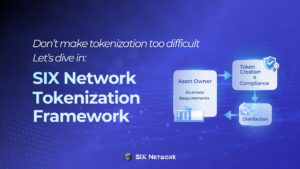
SIX Network Tokenization Framework

If you believe tokenization is difficult, try tokenizing with us first.

Let’s take a deep dive into the “SIX Network Tokenization Framework.”


Key Highlights
• The challenges of tokenization
• SIX Network’s tokenization framework


The process of RWA Tokenization is not something that can be easily built or developed independently. It involves multiple complex steps in order to successfully create a token issuance project for different types of assets.


Challenges of Tokenization

• Strict Regulatory Compliance

One of the biggest challenges lies in regulatory compliance across different jurisdictions. Some countries have not yet officially enabled RWA tokenization, while others impose strict requirements that projects may not initially meet. As a result, licenses must be obtained or project structures must be adjusted to align with legal frameworks, processes that are both complex and time-consuming.


• Customization Gap

Designing and building a successful tokenization structure can be one of the most difficult steps, especially for traditional companies attempting to develop tokenization projects on their own.


• UX & Wallet Experience Still a Barrier

The digital experience of many projects remains difficult for general users to access, making RWA tokenization feel distant and unfamiliar to the broader market.


• Fragmented Infrastructure

Tokenization-related systems remain fragmented across legal frameworks, asset data, financial systems, and blockchain infrastructure, making integration across these components highly complex.


Even for those within the Web3 industry, RWA remains a challenging space. 

This is why specialized tools and experienced tokenization providers are essential to ensure projects can move forward efficiently and smoothly. It is therefore understandable why many perceive tokenization as difficult and inaccessible, often simply because they have not yet seen the SIX Network framework.


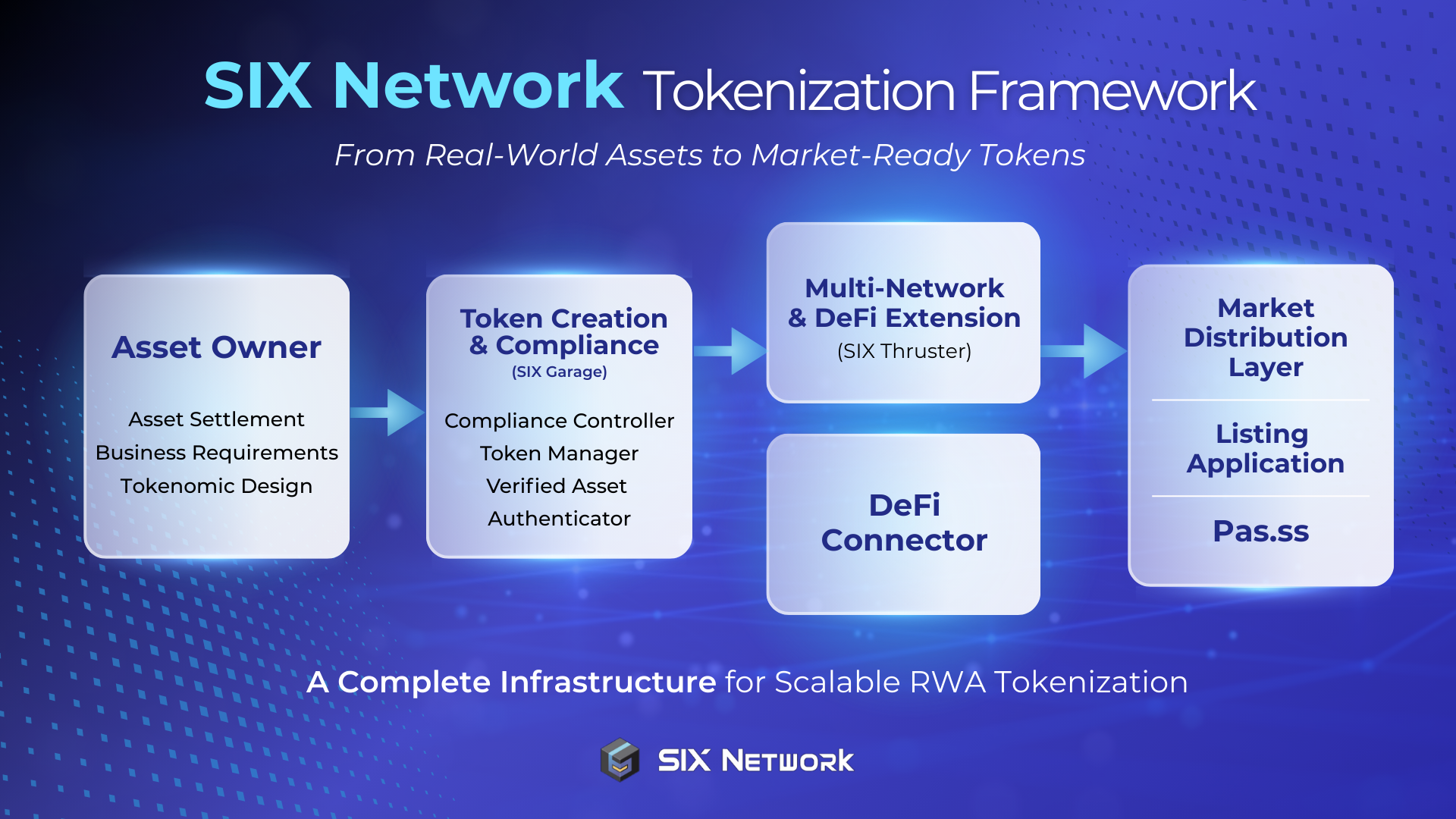
SIX Network Tokenization From Real-World Assets to Market-Ready Tokens 

As a blockchain solutions provider specializing in RWA tokenization, SIX Network offers a comprehensive solution for transforming real-world assets into digital assets through a tool called SIX Garage, which was introduced during our 2025 roadmap live session.


We have designed a complete tokenization structure
from start to finish as follows.


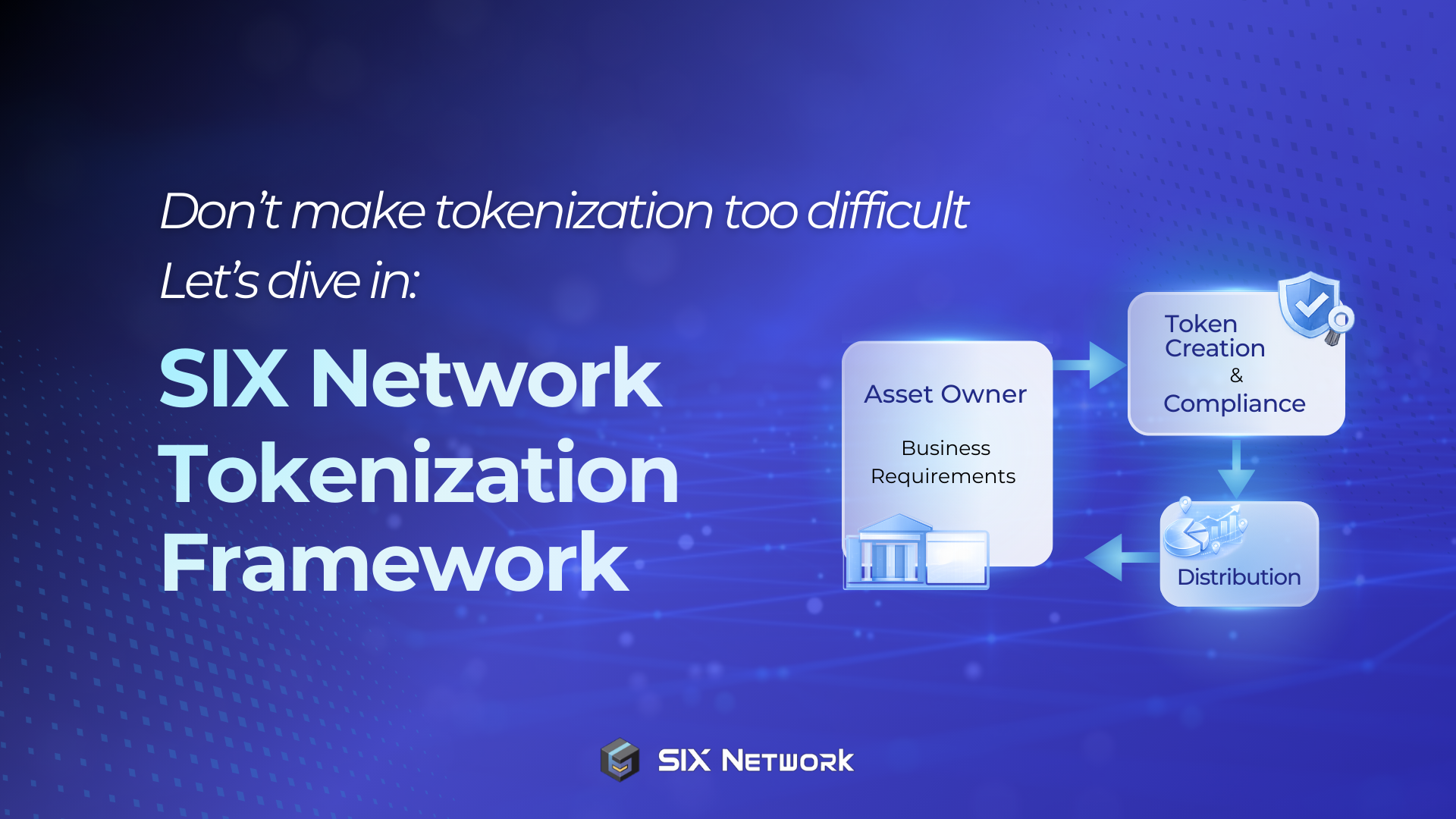
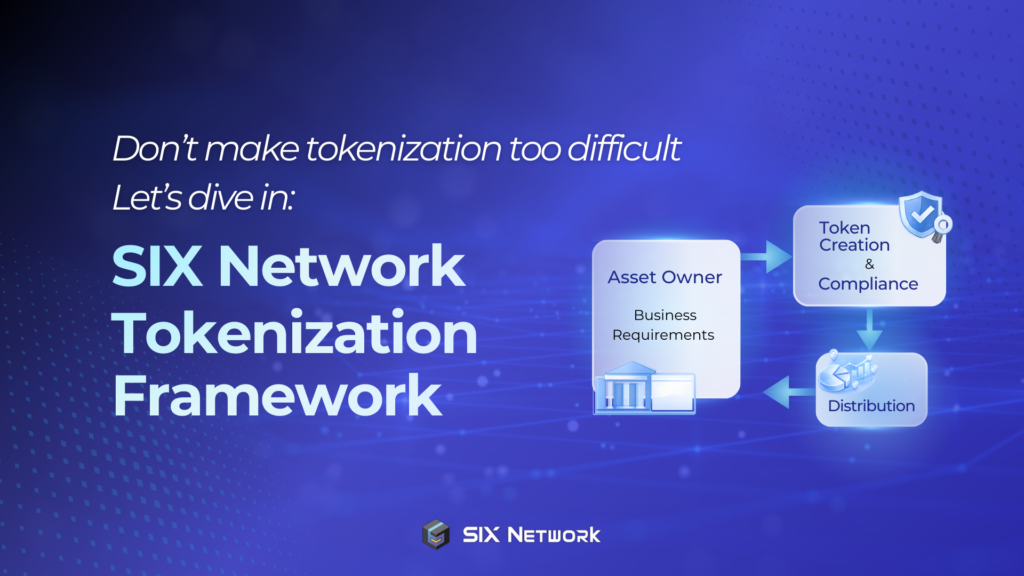
SIX Network Tokenization From Real-World Assets to Market-Ready Tokens


SIX Network Tokenization Framework
A structured approach to preparing digital assets for token issuance, from start to finish.


📝 Starting with the Asset Owner
The first step involves working closely with asset owners or businesses to gather and analyze business requirements comprehensively.

This stage covers:
• Defining asset ownership structures and settlement mechanisms
• Designing tokenomics aligned with revenue models and investment strategies


🧑🏻‍🔧 Creation Stage
Once requirements are clearly defined, the process moves into the Creation stage.
Token Creation marks the official start of tokenization, entering the “race track.”


Key components of this stage include:

• Compliance Controller: A system that enforces regulatory requirements such as age restrictions, investor types, and jurisdiction-based rules to ensure full legal compliance.

• Token Management: Managing token rights and conditions, including transfer restrictions, eligibility rules, age requirements, and country-based access controls.

• Asset Verification & Authenticator: A critical step to verify the authenticity and legitimacy of real-world assets before tokenization, along with identity and permission verification for both issuers and token holders to ensure security and trust.


🌬️ Thruster: Accelerating Tokenization
After tokens are created, they require a powerful engine to accelerate performance on the track, this is where Thruster comes in.


Thruster consists of Multi-Network support, DeFi Extensions, and DeFi Connectors, enabling tokens to connect seamlessly across multiple blockchains and financial systems. This layer enhances scalability, usability, and liquidity for tokenized assets.


🏎️ Entering the Market
The final phase involves bringing tokens into real trading environments.
SIX Network does not perform this step alone, we collaborate with licensed third-party partners specializing in token listing and sales to ensure regulatory compliance and market readiness.


🏁 Crossing the Finish Line
Once tokens are officially launched or fundraising is successfully completed, the project reaches the finish line. The next step is distributing returns, such as dividends or project benefits, through Pas.ss, ensuring transparent and systematic reward distribution to token holders.


──────────────────────────────────


SIX Network is ready to provide end-to-end tokenization services, transforming real-world assets into digital assets with enterprise-grade blockchain infrastructure designed for institutional and large-scale projects.


For organizations interested in tokenization or integration
with the SIX Protocol, please contact us at 👉🏼 https://zeeg.me/sixnetwork

Learn more about SIX Network:

Website l Telegram l Twitter l Facebook l Discord l Medium

⎯⎯⎯⎯⎯⎯⎯⎯⎯⎯⎯⎯⎯⎯⎯⎯⎯⎯⎯⎯⎯⎯⎯⎯⎯⎯⎯⎯⎯⎯⎯⎯

Disclaimer:

1.This article is intended for informational purposes only. Please conduct your own research before making any investment decisions related to cryptocurrencies 2. Cryptocurrency and digital token involve high risk; investors may lose all investment money and should study information carefully and make investments according to their own risk profile.


Don’t miss out follow us at:

Warisara Thepsiri
Warisara Thepsiri

Experience the magic of Blockchain with SIX Network!

Related Posts

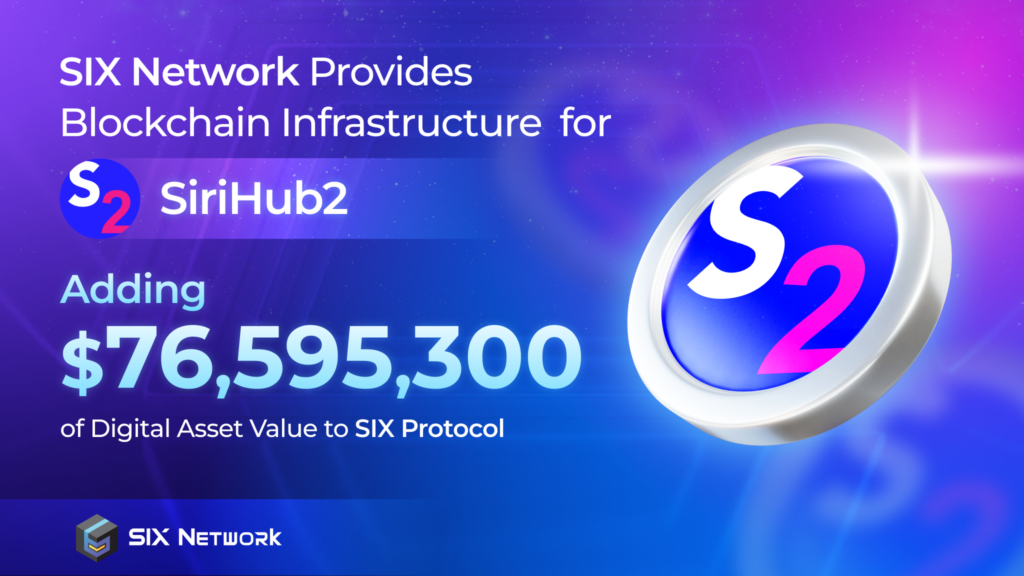
SIX Network Provides Blockchain Infrastructure for SiriHub2, Adding 2.49 Billion THB of Digital Asset Value to SIX Protocol

SIX Network Provides Blockchain Infrastructure for SiriHub2, Adding 2.49 Billion THB of Digital Asset Value to SIX Protocol

SIX Network Provides Blockchain Infrastructure for SiriHub2, Adding 2.49 Billion THB of Digital Asset Value to SIX Protocol

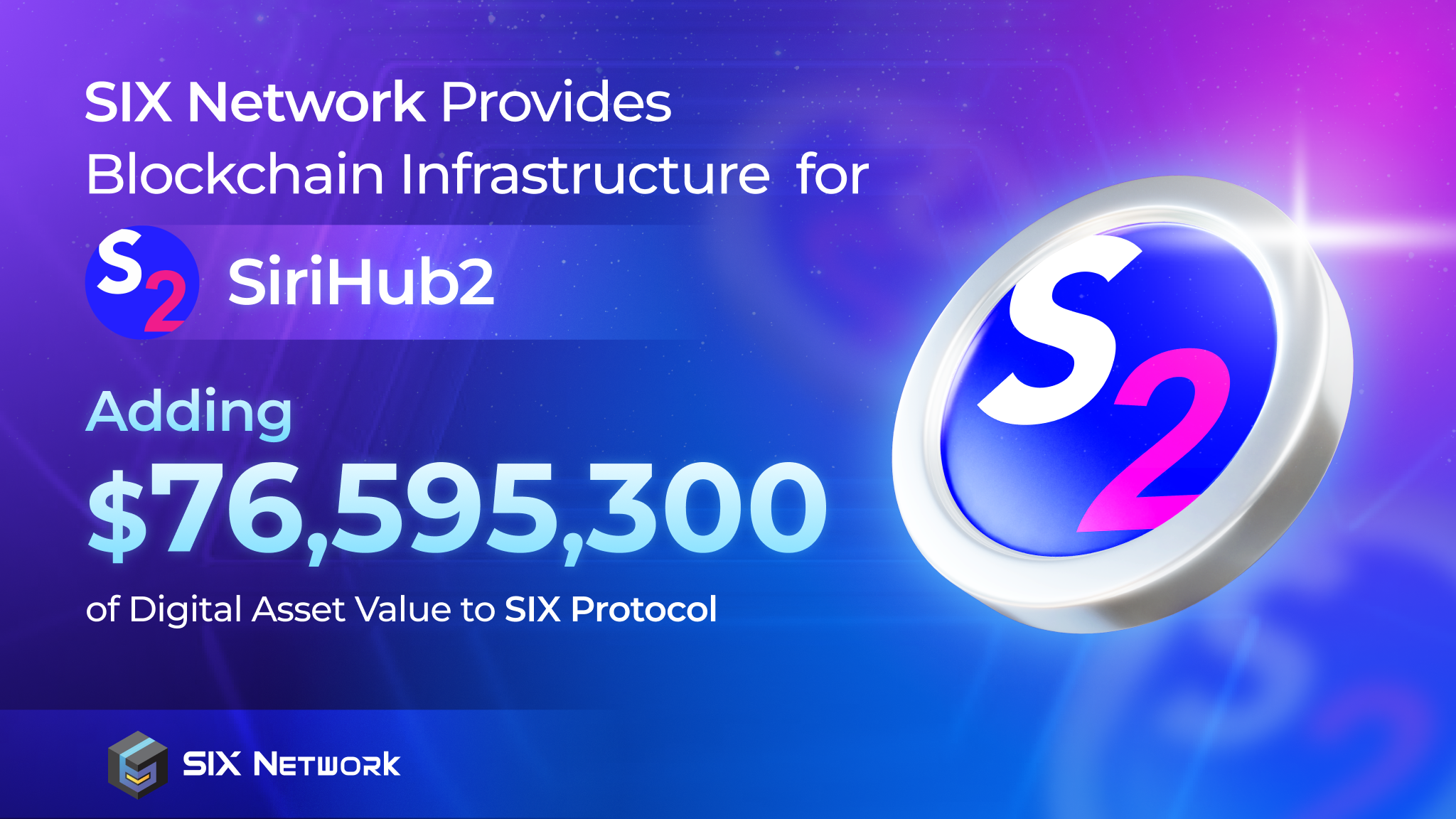
SIX Network is pleased to announce that SiriHub2, a real estate-backed digital investment token, has selected SIX Protocol as the blockchain infrastructure for issuing digital tokens in this project.


The SiriHub2 project has a total fundraising value of $76,595,300 USD, with XSpring Digital serving as the Digital Token Offering System Provider (ICO portal), approved by the Securities and Exchange Commission of Thailand (SEC).


The issuance of this digital token reflects the developer’s confidence in a blockchain system designed to support enterprise-grade use cases, especially in the digital asset market, where real-world assets are used as backing.


SiriHub2: Real Estate-Backed Token Expands Success With $76 Million Fundraising on SIX Protocol

SiriHub2 is an investment token backed by the SIRI Campus office buildings, with an appraised income-based valuation of over $78.0 million and a fundraising target of $76.9 million. The digital token issuer and project owner collaborated with experts from various fields, including legal, valuation, and licensed digital token offering providers.


Token holders are entitled to returns generated from rental income of the SIRI Campus office buildings, located within the T77 community on Sukhumvit 77, a growing district integrating residential, education, and future business hubs. Returns are distributed quarterly at a fixed rate of 6% per year, with principal repayment at project maturity, along with voting rights related to the project.


SiriHub2: One of the Most Anticipated Investment Token Projects in Thailand’s Capital Market

SiriHub2 is a continuation of the highly successful SiriHub Token. This time, the project also received strong investor interest, successfully selling out all tokens, reflecting overwhelming confidence from the market.


With its high-quality real estate asset, SIRI Campus, located in a prime Sukhumvit-area location, the project has drawn wide attention from investors seeking secure assets with predictable returns.


Beyond being a high-potential real estate project, SiriHub2 serves as an important example of how blockchain technology and Real-World Asset Tokenization (RWA) can be integrated seamlessly with real-world assets. It demonstrates that RWA can now be applied in capital markets and deliver new investment products that are transparent, verifiable, and accessible to a broader group of investors.


SIX Protocol: A Blockchain Network Designed for Enterprise-Scale Projects

SIX Protocol is the blockchain network developed by SIX Network, built specifically to support enterprise-level Real World Asset Tokenization projects. It provides the standards and security required for large-scale initiatives across corporations and institutions, while also meeting regulatory compliance requirements.


SiriHub2 uses SIX Protocol as its blockchain network to record and manage all information related to the issuance and transfer of digital tokens. These processes operate through Smart Contracts designed to ensure transparency, verifiability, and immutability, making it suitable for investment tokens backed by real-world assets.


SIX Protocol also utilizes the Proof of Staked Authority (PoSA) mechanism, where validators are selected based on reliability and capability to maintain the network. This enhances system security and stability, which is crucial for managing high-value enterprise assets.


The SiriHub2 offering was conducted through a licensed ICO Portal in accordance with regulatory requirements, with XSpring Digital serving as the Digital Token Offering System Provider. SIX Protocol was selected as the blockchain network for token issuance due to its capabilities that align with the project’s operational needs.


The Success of SiriHub2 Strengthens SIX Protocol as a Blockchain for RWA Tokenization

SiriHub2 is another high-value digital token project utilizing SIX Protocol as its underlying network. This demonstrates that SIX Protocol meets the standards required for large-scale, legally compliant Tokenization projects, an important factor for enterprises seeking reliability in digital asset initiatives.


This success reinforces confidence among corporations and large organizations considering digital asset development, positioning SIX Protocol as a trusted infrastructure choice. Additionally, the increased value of tokenized assets on SIX Protocol further strengthens the ecosystem’s credibility and attracts interest from other developers, creating a positive growth cycle.


Working with major enterprises and supporting high-value Real-World Asset Tokenization is a strategic direction SIX Network continues to pursue. Increased usage on the network directly benefits SIX Token, the native token used for transaction fees and on-chain activities. The more usage generated, the higher the demand for SIX Token, contributing to sustainable long-term ecosystem growth.

Learn More about SIX Network:

Website l Telegram l Twitter l Facebook l Discord l Medium

⎯⎯⎯⎯⎯⎯⎯⎯⎯⎯⎯⎯⎯⎯⎯⎯⎯⎯⎯⎯⎯⎯⎯⎯⎯⎯⎯⎯⎯⎯⎯⎯

Note:

1.This article is intended for informational purposes only. Please conduct your own research before making any investment decisions related to cryptocurrencies

2. Cryptocurrency and digital token involve high risk; investors may lose all investment money and should study information carefully and make investments according to their own risk profile.

Don’t miss out follow us at:

Warisara Thepsiri
Warisara Thepsiri

Experience the magic of Blockchain with SIX Network!

Related Posts

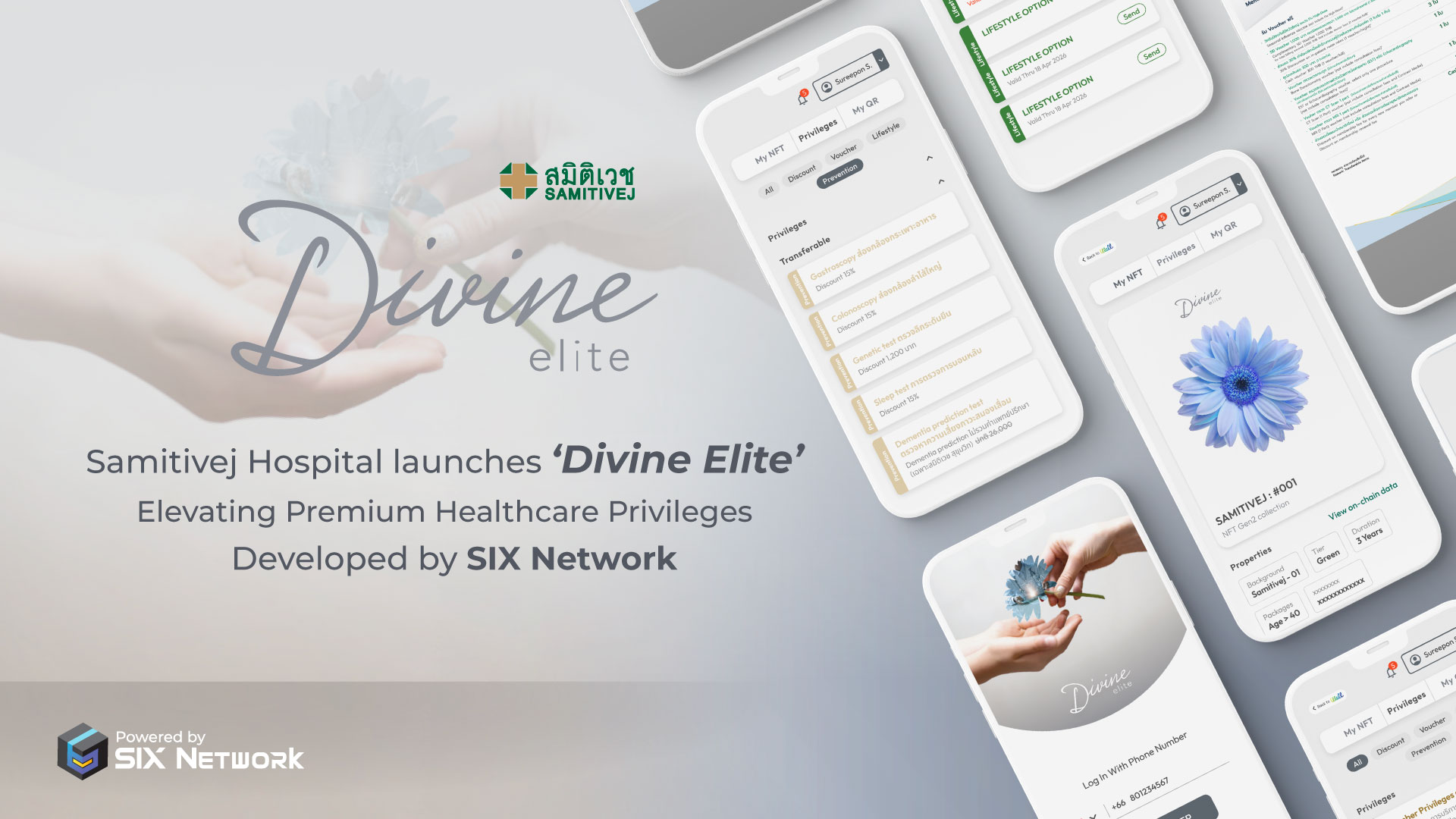
Samitivej Launch the Divine Elite Web Application, Developed by SIX Network to Elevate the Premium Member Experience

Samitivej Launch the Divine Elite Web Application, Developed by SIX Network to Elevate the Premium Member Experience

Samitivej Hospital Unveils the Divine Elite Web Application, Developed by SIX Network to Elevate the Premium Member Experience

Samitivej Hospital introduces the ‘Divine Elite’ web application, a comprehensive healthcare program designed for all lifestyles and ages. Developed in partnership with leading technology company SIX Network, this latest innovation aims to transform the management of medical privileges and elevate the healthcare experience for Divine Elite members. The app allows members to access modern healthcare services with a variety of benefits that can even be shared with loved ones at the touch of a button.


Exclusive Privileges for Divine Elite Members The Divine Elite web application offers a full-service healthcare program, providing tailored benefits to Samitivej Hospital’s premium members. Members can choose a membership package that suits their needs 3, 5, or 10 years and enjoy health checkups and discounts on treatments at Samitivej Hospital. Additionally, the app allows easy management of benefits, accessible through the Well by Samitivej application, with the freedom to share these privileges with family or close friends.


Sharing Care at Your Fingertips Divine Elite is not just about offering exclusive benefits to members, but also about sharing care with loved ones. Members can easily transfer their privileges, turning them into gifts for those they care about. The recipients will receive a custom package for medical services at Samitivej Hospital.


How SIX Network’s Technology Powers the Divine Elite Web Application The Divine Elite web application is powered by advanced technology from SIX Network, integrating the SIX Protocol and Dynamic Data Layer to enhance security, speed, and flexibility in managing data and privileges. The Dynamic Data Layer ensures fast, secure updates of health benefits, medical information, and transfers of privileges. This technology also enables the seamless transfer of digital assets, such as NFTs, making Divine Elite a powerful tool for managing healthcare privileges at Samitivej Hospital.

A New Experience for Divine Elite Users

Comprehensive Privilege Management: Members can view, transfer, and manage all their healthcare privileges within the web application.

Flexible Use of Benefits: Members have the freedom to choose benefits that suit their needs throughout their membership period.

Share Care: Members can easily transfer their privileges to loved ones as gifts, with just a few clicks in the app.


Never Miss Out on Privileges: Members receive notifications when their benefits are about to expire or when new benefits become available, ensuring they never miss out on valuable opportunities.

In addition to offering full-service healthcare, the blockchain technology behind Divine Elite paves the way for a new business ecosystem, allowing Samitivej Hospital and its partners to expand their network of privileges in the future.


Samitivej Hospital believes that Divine Elite will enhance the customer experience through blockchain technology, while also improving the hospital’s overall management efficiency.


Those interested can now access Divine Elite, a full-service healthcare program for members, through the Well by Samitivej application.

iOS / Android: [Link] https://qrco.de/wellbysamitivej

Learn More about SIX Token and SIX Network:

Website l Telegram l Twitter l Facebook l Discord l Medium
 

Note:

1.This article is intended for informational purposes only. Please conduct your own research before making any investment decisions related to cryptocurrencies


2. Cryptocurrency and digital token involve high risk; investors may lose all investment money and should study information carefully and make investments according to their own risk profile.

Please stay tuned for more at

——————————————–

Follow SIX Network 

https://linktr.ee/Sixnetwork

Join Discord

https://discord.gg/sixnetwork

Don’t miss out follow us at:

Warisara Thepsiri
Warisara Thepsiri

Experience the magic of Blockchain with SIX Network!

Related Posts

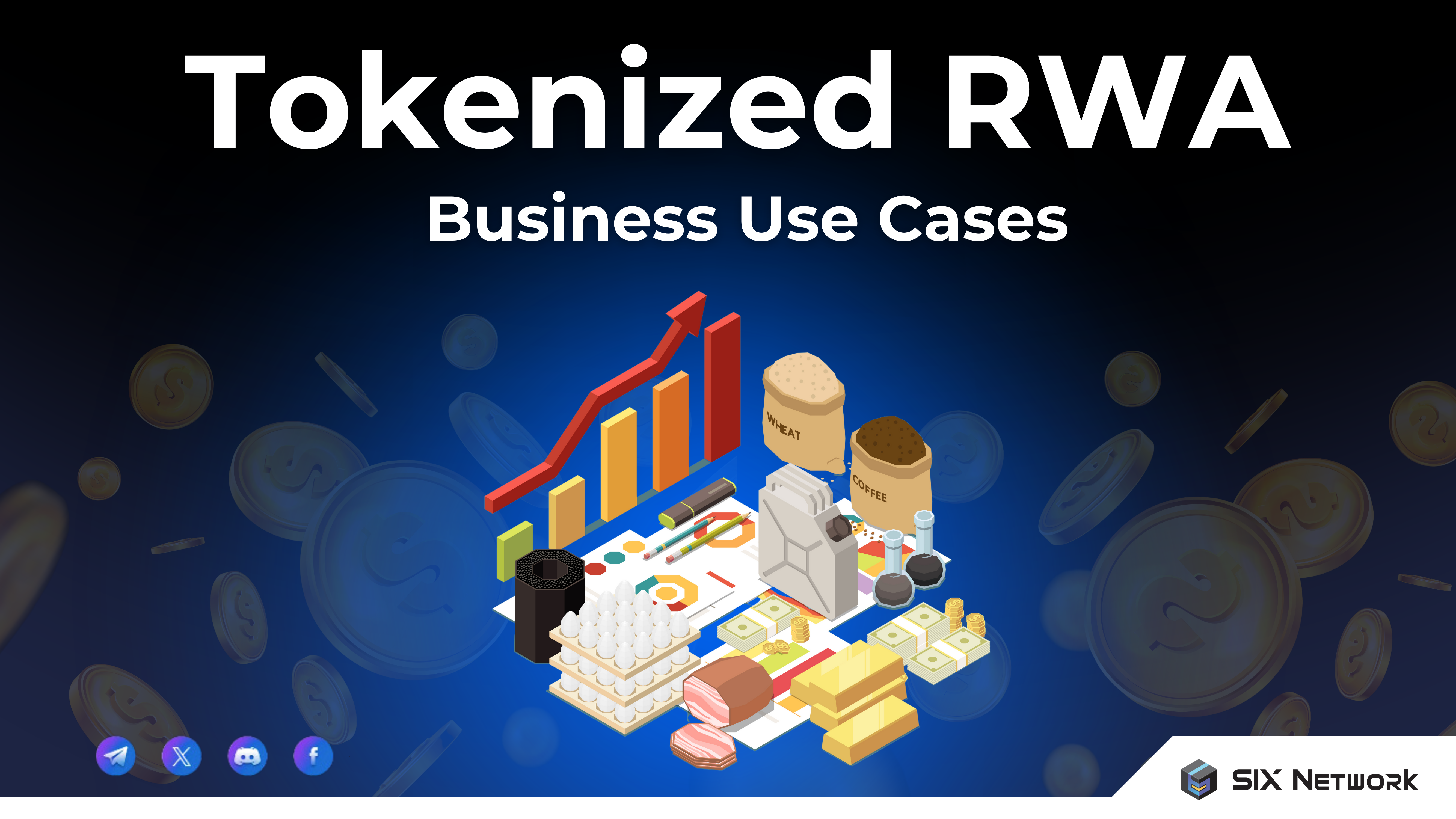
The Business Use Cases Behind Tokenizing Real-World Assets (RWAs)

The Business Use Cases Behind Tokenizing Real-World Assets (RWAs)

Tokenized RWA - SIX Network

RWA tokenization is the process of converting real-world assets (e.g., financial assets, real estate, art, commodities) into digital tokens via smart contract on a blockchain. Each token represents a share or ownership in the underlying asset, allowing for fractional ownership.


Tokenization offers several key features and benefits, including fractional ownership, increased liquidity, transparency through blockchain records, and lower costs due to reduced paperwork and intermediaries.

Understanding The Tokenization of Real-World Assets (RWAs)

The process of tokenizing RWAs involves selecting assets, defining token specifications, connecting to off-chain data for asset backing, deploying smart contracts, and issuing tokens. Blockchain technology is ensuring the immutability and tamper-proof integrity of these tokens.


Blockchain technology supports RWA Tokenization by providing a transparent and immutable record of ownership. This enables secure, direct, and efficient trading between parties, reducing transactional costs and increasing asset liquidity. Smart contracts on the blockchain automate processes and enhance security.

Importance of The Tokenization of RWAs

Tokenizing RWAs brings advantages for both asset owners and investors

There are several potential benefits to tokenizing real-world assets (RWA): 

• Fractional Ownership: Enables smaller investors to buy and trade tokens, increasing liquidity.

• Global Accessibility: Tokenized assets can be traded 24/7 on global markets, democratizing investment opportunities.

• Decentralized Record-keeping: Transactions are securely recorded on a decentralized ledger, ensuring transparency and auditability, boosting trust and reducing fraudulent risks.

•  Fractionalization Benefits: Assets can be divided into smaller parts, offering flexibility in ownership, management, and the creation of new investment products.

•  Diversification: Investors can diversify portfolios and access a wider range of asset classes by tokenizing traditional financial instruments.

Business Use Cases Examples for The Tokenization of RWAs

Real estate: Real Estate Tokenization, exemplified by the RealX Investment Token, transforms real estate investment by enabling fractional ownership. This innovative approach, similar to the RealX Token, exemplifies how investors can own a portion of high-value real estate assets. Such fractional ownership broadens market participation and simplifies the transfer of ownership, fostering a more efficient and transparent ecosystem.


Art and collectibles: Tokenization unlocks value in art and collectibles by allowing individuals to own fractions of valuable artworks. This democratizes access to high-value items and creates new avenues for investment. For example, a company named Freeport offered fractionalized shares of Andy Warhol paintings, allowing people to own a portion of valuable artworks.


Financial industry: Blockchain technology is already being used by established financial giants like BlackRock, Fidelity, BNY Mellon, JP Morgan, Goldman Sachs, UBS, and HSBC to tokenize a variety of real-world assets. These institutions are starting to place tokenized products with their customers, going beyond simply tokenizing assets for operational uses and savings like repo and collateral management.

Dynamic Data Layer - SIX Network

SIX Network’s Role in Blockchain Business Uses

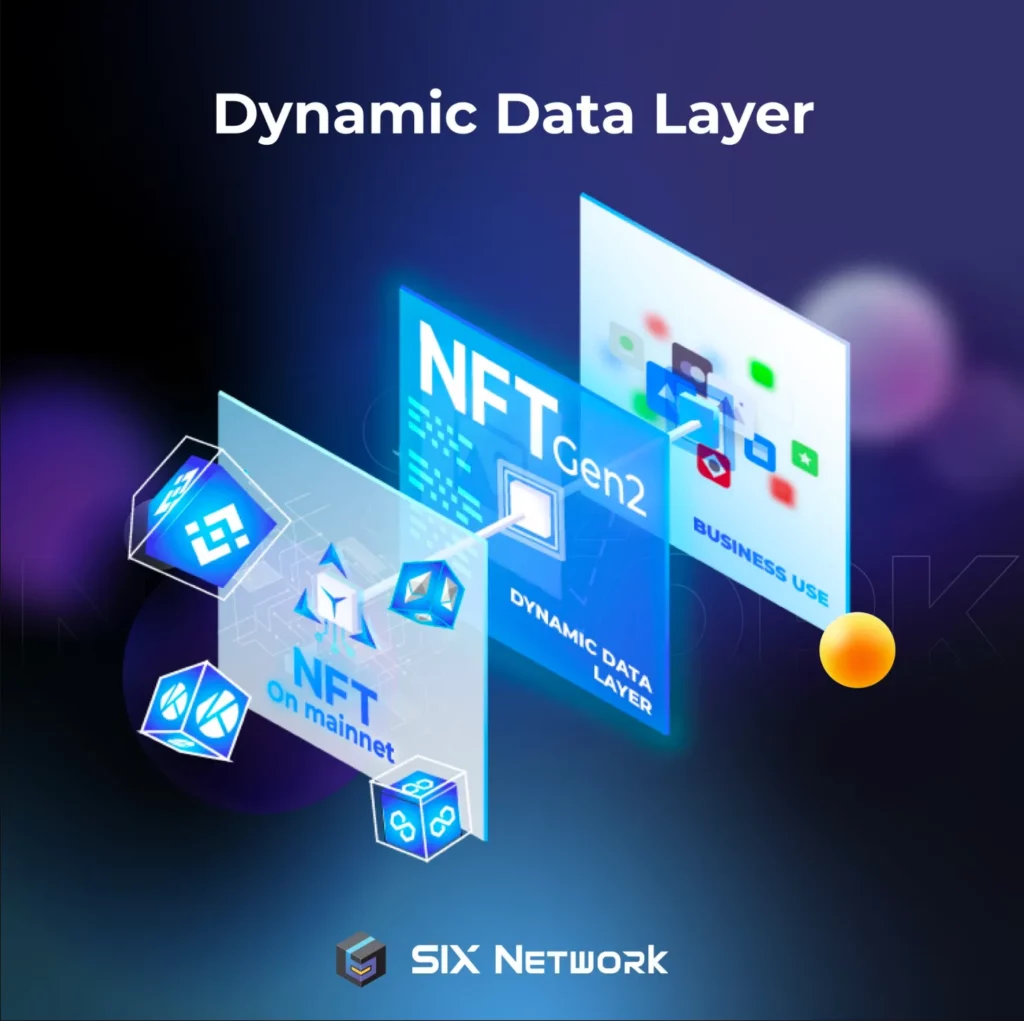
SIX Network’s unique Dynamic Data Layer is a practical approach to blockchain business use cases. This layer, built on the SIX Protocol, serves as the data management layer within the SIX Protocol blockchain architecture.


Here’s a concise overview of SIX Network’s role in blockchain business uses:

1.Infrastructure Layer: SIX Protocol

• The foundational layer provides support and it is a foundation for the entire blockchain system. 

  •  
  • 2.Data Layer: Dynamic Data Layer (DDL)
  • • Positioned on top of the SIX Protocol, DDL manages data within the blockchain.
  • • Empowers businesses with adaptability, allowing dynamic changes to digital assets data.
  • • Stores and exchanges dynamic metadata of specific digital assets, enabling real-world applications.
  1.  
  2. 3. Presentation Layer: NFT Gen2
  • • The user-facing layer was built on the Dynamic Data Layer.
  • • Presents digital assets features, functionalities, and use cases in a user-friendly way.


SIX Network’s role in blockchain business revolves around providing a dynamic and adaptable data layer, enabling businesses to leverage digital assets in innovative and practical ways, from enhancing user engagement at events to creating valuable, real-world applications for digital assets. For more information, you can explore SIX Network’s website or learn more on how to Level Up your Business with SIX Network’s ‘Dynamic Data Layer’.


Learn More about SIX Network:

Website l Telegram l Twitter l Facebook l Discord l Medium
——————————————–


Follow SIX Network 

https://linktr.ee/Sixnetwork

Join Discord

https://discord.gg/sixnetwork

Don’t miss out follow us at:

Chalermlak Woraurai
Chalermlak Woraurai

Experience the magic of Blockchain with SIX Network!

Related Posts