fbpx

Tokenization Signals #5: Preparing for RWA Phase 2

Tokenization Signals #5: Preparing for RWA Phase 2

Tokenization Signals #5: Preparing for RWA Phase 2. Is developing infrastructure to support financial institutions enough?

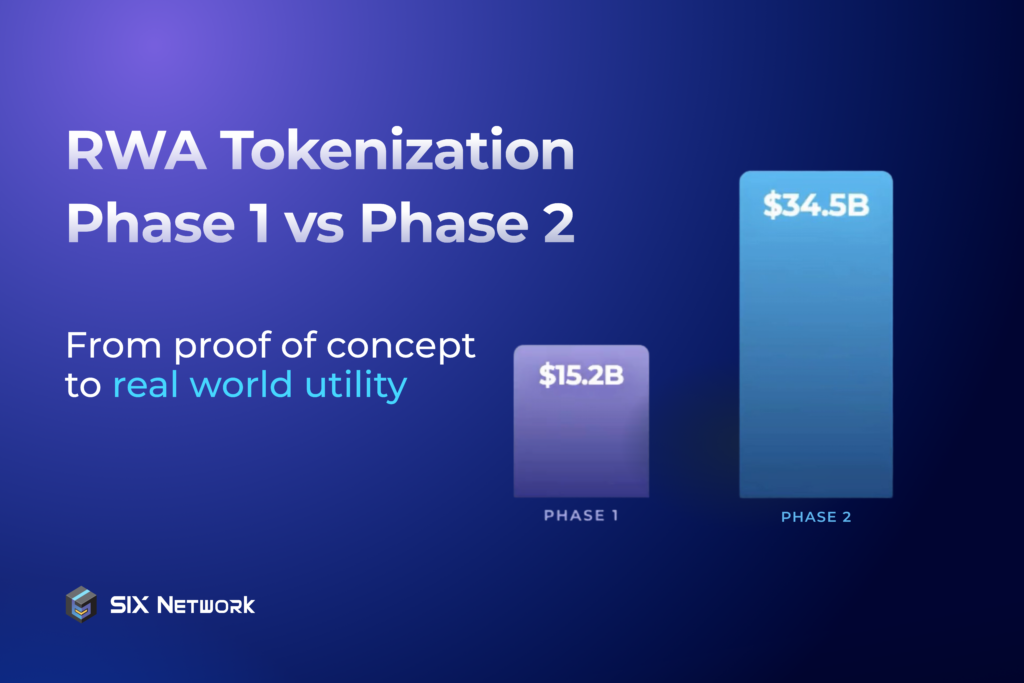
RWA is starting to enter the early stage of Phase 2, as we previously explored in the article RWA Entering Phase 2. From Phase 1, the period that proved assets could be tokenized on blockchain, the market is now moving into a stage focused on building real use cases, with development coming from global financial institutions.


This is a period of preparation for much larger growth and expansion than before. From this point onward, more institutional-level players are expected to enter the market. This is why we should prepare the structure to support growth alongside the RWA market.


So, with SIX Network’s roadmap this year focusing on “Institutional Assets and Digital Financial,” is preparing infrastructure to support these assets enough?

Looking Back at the Timeline Before Entering Phase 2


In 2024, the RWA market proved that financial institutions could accept tokenization. BlackRock launched BUIDL and people bought it. Franklin Templeton launched BENJI and people bought it. The market grew 85% in a single year.


But what happened in 2025 and continues until now is different. Institutions are no longer just investing in tokenized assets. They are using them further, such as using them as collateral for trading on decentralized exchanges or connecting them with DeFi, as seen in the case of BlackRock BUIDL being placed on Uniswap.


This was the first time we saw a regulated project appear on a decentralized exchange.


That is the dividing line between Phase 1 and Phase 2.


Market Direction from Phase 1 to Phase 2


In Phase 1, the TVL numbers of the RWA market clearly showed that the market was still at the beginning of full expansion. Treasury and private credit accounted for 70-73% of total market value. Both are assets that institutions are already familiar with in terms of lower risk and verifiable yield. The highlight of Phase 1 was BlackRock’s BUIDL, which became the world’s largest tokenized fund within just a few months after launch and proved that institutional-grade asset tokenization could actually work.


Entering Phase 2, the overall picture began to change as tokenized commodities grew by 289%, from $1.43 billion to $5.55 billion. Tokenized stocks, which only began in mid-2025, rose to $487 million. The market share of Treasury declined from 73.7% to 67.2%, not because Treasury shrank, but because other asset classes grew faster. All of this happened within Q1 2026.


What shows that Phase 2 has truly arrived is not only the larger numbers, but the change in behavior. Beyond bringing assets into tokenization for investment, tokenization is becoming digital financial infrastructure that can already be used as collateral for transactions on blockchain. Today, tokenization is infrastructure that the global financial system is building together.


At a time this intense, is simply developing RWA infrastructure enough?


SIX Network’s Preparation


SIX Network has seen the growth of the market and the entry of institutional players ahead of time. This aligns with our 2026 roadmap theme, “Institutional Assets and Financial Infrastructure,” which matches the direction the market is currently moving toward.


Although Thailand may still face some challenges around regulatory frameworks and still needs clearer legal direction, the signals this year are becoming more positive. There is growing interest from the business sector, along with continued movement toward building a digital asset framework. The Thai market has significant interest in RWA Tokenization, but it is still waiting to see which use cases will emerge in a clear and concrete form first.


For SIX Network, we already have real use cases through Pas.ss, an on-chain privilege management platform that serves as a bridge for delivering benefits to token holders of different projects. One recent example is Pas.ss connecting special privileges with AQUAROUS Token holders, one of AssetWise’s projects. This is a clear example showing that tokenized assets do not stop at investment, but can expand into real experiences for token holders.


On the asset side, SiriHub2, a real estate project worth 2.49 billion baht, is tokenized on SIX Protocol. Together with other assets, this has brought the total on-chain asset value on SIX Protocol to more than $90 million. All of these are real assets from real businesses in this region.


So, is infrastructure development enough?


The structure is already ready for use. What comes next is expanding use cases and supporting new players that are entering alongside the growth of Phase 2.

Follow every update at
Website: https://six.network/
X: https://x.com/theSIXnetwork
FB: https://www.facebook.com/thesixnetwork/


And our community channels:

Discord: http://discord.gg/sixnetwork
Telegram: https://t.me/+0BmqYVoV5j5lN2Jl

⎯⎯⎯⎯⎯⎯⎯⎯⎯⎯⎯⎯⎯⎯⎯⎯⎯⎯⎯⎯⎯⎯⎯⎯⎯⎯⎯⎯⎯⎯⎯⎯

Disclaimer:

1.This article is intended for informational purposes only. Please conduct your own research before making any investment decisions related to cryptocurrencies 2. Cryptocurrency and digital token involve high risk; investors may lose all investment money and should study information carefully and make investments according to their own risk profile.


Don’t miss out follow us at:

Warisara Thepsiri
Warisara Thepsiri

Experience the magic of Blockchain with SIX Network!

Related Posts

SIX Network Announces Strategic Partnership with Piggycell to Advance RWA Between Thailand and South Korea

SIX Network ประกาศความร่วมมือเชิงกลยุทธ์กับ Piggycell เพื่อร่วมผลักดัน RWA ระหว่างไทยและเกาหลีใต้

SIX Network ประกาศความร่วมมือเชิงกลยุทธ์กับ Piggycell บริษัทจากเกาหลีใต้ที่พัฒนาโครงสร้างพื้นฐาน Real-World Asset สำหรับพลังงานเคลื่อนที่ ภายใต้แนวคิด RWA Infrastructure for Mobile โดย Piggycell นำพลังงานในโลกจริง มาเชื่อมต่อกับระบบ Web3 ผ่าน DePIN

Read More

RWA Landscape 2026: The Market Structure Is Changing

RWA Landscape 2026: The Market Structure Is Changing

RWA Tokenized Landscape 2026: A snapshot of how RWA is expanding across infrastructure, asset classes, and institutional adoption

The RWA market in 2026 has undergone a meaningful structural shift. Its size has grown, asset types have become more diverse, institutional players are gradually entering the space, and the way the market operates has changed in less than two years. This article provides an overview of where the market stands today and who is doing what.

Infrastructure: The Networks Where Everything Runs On-Chain


Ethereum still dominates the market with more than 56% of total on-chain RWA value. The main reason is its deep DeFi ecosystem, which allows tokenized assets on Ethereum to be used as collateral, traded on DEXs, and connected with a wider range of protocols than other networks.


Beyond Ethereum, other networks have different strengths. Stellar is the main base for Franklin Templeton BENJI, Solana supports Ondo Global Markets tokens, Polygon and Avalanche continue to see more tokenized products, and BNB Chain has seen its RWA TVL double to reach $4 billion this year.


For Southeast Asia, SIX Protocol is infrastructure specifically designed for RWA Tokenization, with a focus on compliance and support for each country’s regulatory requirements from the beginning.


Asset Types: From Treasury to Multi-Asset Diversification


At the beginning of 2025, more than 70% of the RWA market was the U.S. Treasury. But the picture has changed in 2026.


U.S. Treasuries still account for $14.79 billion across 82 products and 65,729 holders, led by Circle USYC at $2.9 billion, Ondo at $2.8 billion, BlackRock BUIDL at $2.5 billion, and Franklin Templeton BENJI at $2.5 billion.


But Private Credit has now surpassed Treasury to become the largest segment in the market, driven by Figure Technologies and Maple Finance, which allow institutions that previously could not access private credit markets to participate through tokenized infrastructure.


Commodities have reached $7.3 billion, led by gold, which accounts for most of the segment through PAXG and XAUT. Corporate Bonds stand at $1.77 billion, while Tokenized Equities only began in mid-2025 but have already reached $960 million by early 2026, led by Ondo Global Markets with more than 100 tokenized stocks and ETFs.


TradFi Has Become the Main RWA Player, Followed by Crypto-Native Players


The institutional financial player creating the clearest use case this year is BlackRock, whose BUIDL has become a model project for institutional-level RWA adoption, including its filing to register two additional tokenized funds with the SEC in May. Franklin Templeton has expanded BENJI across multiple networks, while UBS issued a tokenized bond in 2025.


On the crypto-native side, Ondo Finance continues to show recurring use cases, controlling 60% of the tokenized equities market and launching Ondo Global Markets in early 2026. In private credit, Centrifuge and Maple Finance remain key players.


At the same time, global settlement service provider DTCC announced that it will begin real tokenized securities in July, while four global banks, JPMorgan, Citi, Bank of America, and Wells Fargo, are working on a shared tokenized deposit network through The Clearing House, targeting 2027.


Who Is Driving Demand?

Actual users in the RWA market in 2026 can be clearly divided into three groups.

• The first group is financial institutions seeking verifiable on-chain yield and faster settlement than traditional systems.

• The second group is fund managers and asset managers using Tokenization as a tool to diversify portfolios and access new markets.

• The third group is businesses and asset owners looking to tokenize their own assets to access new investors and increase liquidity.


What is notable is that demand from these three groups does not depend on crypto market sentiment. It is driven by yield, cost, and system efficiency, which is why the RWA market continues to grow even when the broader crypto market corrects.


SIX Network’s Movement Within This Landscape


While global players are building infrastructure for tokenized securities and deposits, Southeast Asia faces a different set of challenges. Most assets in this region, including real estate, energy projects, and business assets, still do not have tokenization infrastructure that can support them according to the regulations of each country.


Today, SIX Protocol has more than $90 million in real-world assets on-chain through projects such as SiriHub2 and KAVALON Token, proving that tokenization can work in the context of the Thai market and the wider region. With SIX Garage and its built-in Compliance Controller, we are ready to support market expansion in an era where RWA is becoming part of the financial system’s structure.

Follow every update at
Website: https://six.network/
X: https://x.com/theSIXnetwork
FB: https://www.facebook.com/thesixnetwork/


And our community channels:

Discord: http://discord.gg/sixnetwork
Telegram: https://t.me/+0BmqYVoV5j5lN2Jl

⎯⎯⎯⎯⎯⎯⎯⎯⎯⎯⎯⎯⎯⎯⎯⎯⎯⎯⎯⎯⎯⎯⎯⎯⎯⎯⎯⎯⎯⎯⎯⎯

Disclaimer:

1.This article is intended for informational purposes only. Please conduct your own research before making any investment decisions related to cryptocurrencies 2. Cryptocurrency and digital token involve high risk; investors may lose all investment money and should study information carefully and make investments according to their own risk profile.


Don’t miss out follow us at:

Warisara Thepsiri
Warisara Thepsiri

Experience the magic of Blockchain with SIX Network!

Related Posts

SIX Network Announces Strategic Partnership with Piggycell to Advance RWA Between Thailand and South Korea

SIX Network ประกาศความร่วมมือเชิงกลยุทธ์กับ Piggycell เพื่อร่วมผลักดัน RWA ระหว่างไทยและเกาหลีใต้

SIX Network ประกาศความร่วมมือเชิงกลยุทธ์กับ Piggycell บริษัทจากเกาหลีใต้ที่พัฒนาโครงสร้างพื้นฐาน Real-World Asset สำหรับพลังงานเคลื่อนที่ ภายใต้แนวคิด RWA Infrastructure for Mobile โดย Piggycell นำพลังงานในโลกจริง มาเชื่อมต่อกับระบบ Web3 ผ่าน DePIN

Read More

Compare and Analyze RWA Phase 1 vs Phase 2 Data

Compare and Analyze RWA Phase 1 vs Phase 2 Data

Analyze RWA Tokenization Phase 1 and Phase 2

What Do the Numbers Tell Us, and Where Is the Market Heading Next?

Let’s analyze the numbers behind the RWA Tokenization market as it is beginning to enter Phase 2, which is moving in a meaningfully different direction from the first phase.


Phase 1 was the period when the market proved that Tokenization could actually work. Most assets were U.S. Treasuries or debt instruments that offered clear returns, were easy to verify, and were trusted by institutions.


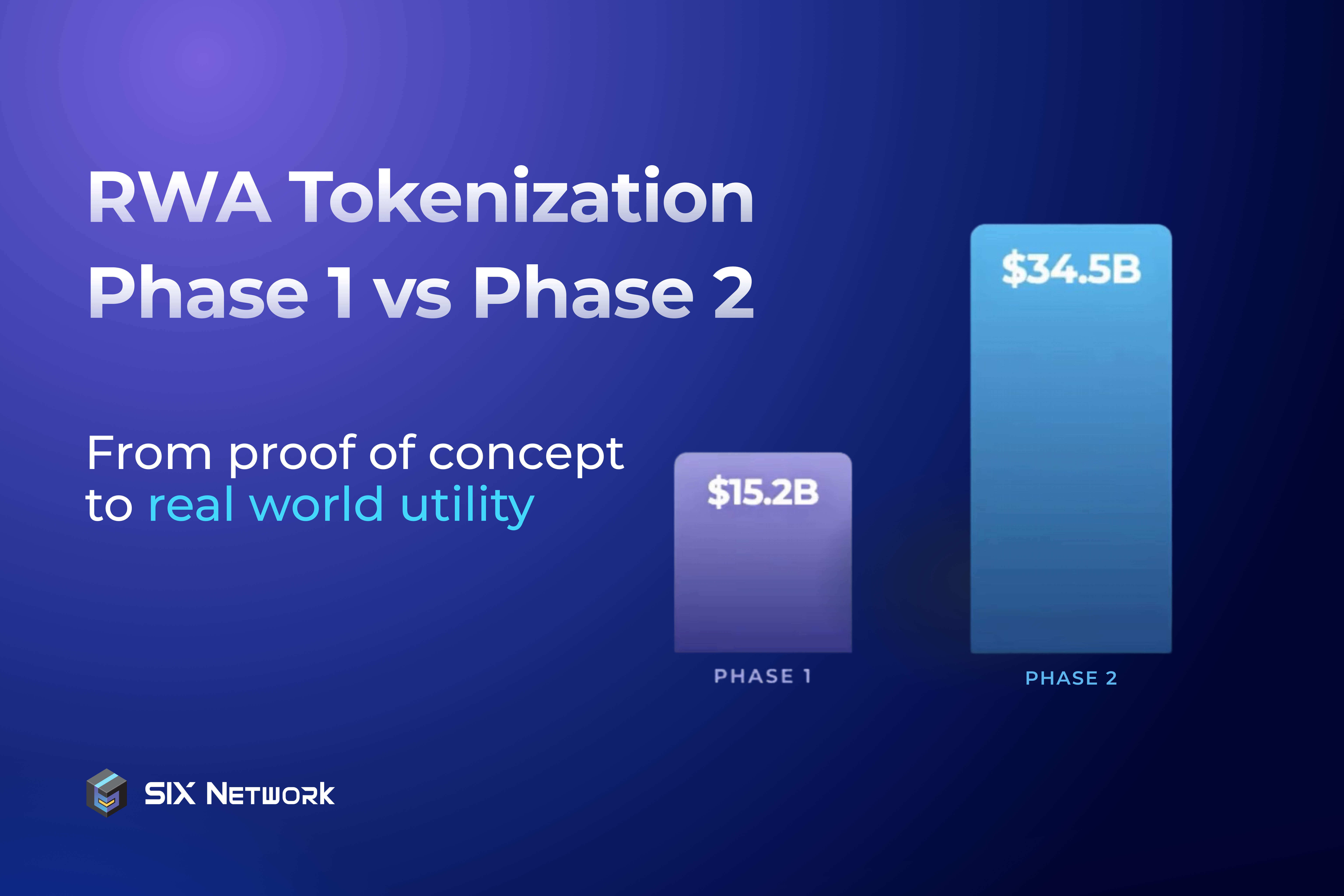
Phase 2 is the period when tokenized assets are starting to be used further in real applications. Private credit has surpassed Treasury to become the largest segment, followed by tokenized stocks growing by 422%, tokenized commodities reaching $7.3 billion, and these assets being used as collateral in the DeFi ecosystem and traded 24/7.


There is also interesting data that emerged between Phase 1 and Phase 2 of RWA, as shown in the following information.


Phase 1 (2023-2024): The Early Stage of Rapid Expansion

In Phase 1, during 2024, the tokenization market was dominated by Tokenized Treasury. BlackRock BUIDL, which launched on Ethereum in March 2024, saw its asset value rise to $500 million within just a few weeks after launch.


The numbers that best reflect Phase 1 are:


The RWA market, excluding stablecoins, expanded by as much as 85% in one year, with market value rising to $15.2 billion in December 2024. Private credit accounted for 65% of the market value, with more than 119 token issuers and as many as 81,304 token holders.


The asset class breakdown in Phase 1 clearly shows that the tokenization market was still in a testing phase, with significant room for further expansion. Treasury and money market funds accounted for 30% of total asset value in the market, while another 61% came from private credit as of early 2025. These two asset types share similar characteristics: returns that are easy to understand, clear, and lower risk.


The signal from Phase 1 was the proof that Tokenization was safe enough and could become a viable option for financial institutions to expand into and become part of digital assets.


Phase 2 (2025-Present): The Stage of Real Usage

2025 marked a turning point, as the market share of Tokenized Treasuries declined from 73.7% to only 67.2% because other asset types began catching up and receiving more support. This caused the numbers in Phase 2 to change as follows:


Tokenized commodities grew by 289%, from $1.43 billion to $5.55 billion in Q1 2026, while tokenized stocks started at $2.09 million in mid-2025 and rose to $486.69 million within the same quarter.


Private credit surpassed Treasury to become the largest segment, partly because it offered better returns than other asset types, and partly because financial institutions started using tokenized assets in more complex real-world contexts, both as collateral for transactions within the DeFi ecosystem and as flexible investment and yield-generating instruments.


A clear use case is BlackRock BUIDL, which began operating a regulated fund on Uniswap in early 2026. This opened the way for holders of tokenized bonds to use them as collateral for lending transactions, while still receiving the original returns of the token according to the holding conditions.


In addition, BlackRock brought BUIDL to be used as collateral on a digital asset trading platform such as Binance, allowing government bonds to become assets that can be used directly as collateral for trading.


This also includes J.P. Morgan, which built its own platform called Onyx, enabling bond trading to happen in real time with a working model similar to crypto.


What the Data Shows When Comparing Both Phases

If we compare Phase 1 and Phase 2 through numbers and behavior:


Phase 1 had as many as 81,304 token holders in 2024. Market value was dominated by Treasury and private credit because both were asset types with qualities that were “explainable and easy to understand,” suitable for institutions, and most use cases stopped at holding assets to receive returns in a straightforward way.


Phase 2 had 65,729 holders of Tokenized Treasury alone in Q1 2026, with more diverse types of digital assets. Commodities grew to nearly three times the size of equities, and what changed beyond the numbers is that tokenized assets are beginning to be used further within the new financial system, both as collateral for trading on Decentralized Exchanges (DEXs) and integrated with DeFi protocols that support this type of usage.


Where Phase 2 Is Heading Next


Based on the data we are seeing now, Phase 2 of tokenization has not yet reached its peak. There are also three clear directions that are likely to happen next.


More diverse asset classes – Tokenized real estate, equities, and commodities beyond gold are still in the early stage. The numbers from Phase 1 indicate that treasury was only the starting point, not the destination.


More complex utility – BUIDL starting to trade on Uniswap is a signal that tokenized assets are entering the DeFi ecosystem more seriously. The next direction is for tokenized assets to be used more in structured products and lending protocols.


Geographic expansion – In 2024-2025, the tokenization market was concentrated in the United States and Europe. In Phase 2, the market is expanding into other regions. Banks in Asia and Central and South America are beginning to issue tokenized instruments on public networks, and regional infrastructure such as SIX Protocol is what allows assets in Southeast Asia to enter this system.


All of this indicates that Phase 2 is not just Phase 1 becoming larger. Tokenization is becoming one of the infrastructures of the financial system and developing into use cases that allow us to see RWA adoption this year.

Follow every update at
Website: https://six.network/
X: https://x.com/theSIXnetwork
FB: https://www.facebook.com/thesixnetwork/


And our community channels:

Discord: http://discord.gg/sixnetwork
Telegram: https://t.me/+0BmqYVoV5j5lN2Jl

⎯⎯⎯⎯⎯⎯⎯⎯⎯⎯⎯⎯⎯⎯⎯⎯⎯⎯⎯⎯⎯⎯⎯⎯⎯⎯⎯⎯⎯⎯⎯⎯

Disclaimer:

1.This article is intended for informational purposes only. Please conduct your own research before making any investment decisions related to cryptocurrencies 2. Cryptocurrency and digital token involve high risk; investors may lose all investment money and should study information carefully and make investments according to their own risk profile.


Don’t miss out follow us at:

Warisara Thepsiri
Warisara Thepsiri

Experience the magic of Blockchain with SIX Network!

Related Posts

SIX Network Announces Strategic Partnership with Piggycell to Advance RWA Between Thailand and South Korea

SIX Network ประกาศความร่วมมือเชิงกลยุทธ์กับ Piggycell เพื่อร่วมผลักดัน RWA ระหว่างไทยและเกาหลีใต้

SIX Network ประกาศความร่วมมือเชิงกลยุทธ์กับ Piggycell บริษัทจากเกาหลีใต้ที่พัฒนาโครงสร้างพื้นฐาน Real-World Asset สำหรับพลังงานเคลื่อนที่ ภายใต้แนวคิด RWA Infrastructure for Mobile โดย Piggycell นำพลังงานในโลกจริง มาเชื่อมต่อกับระบบ Web3 ผ่าน DePIN

Read More