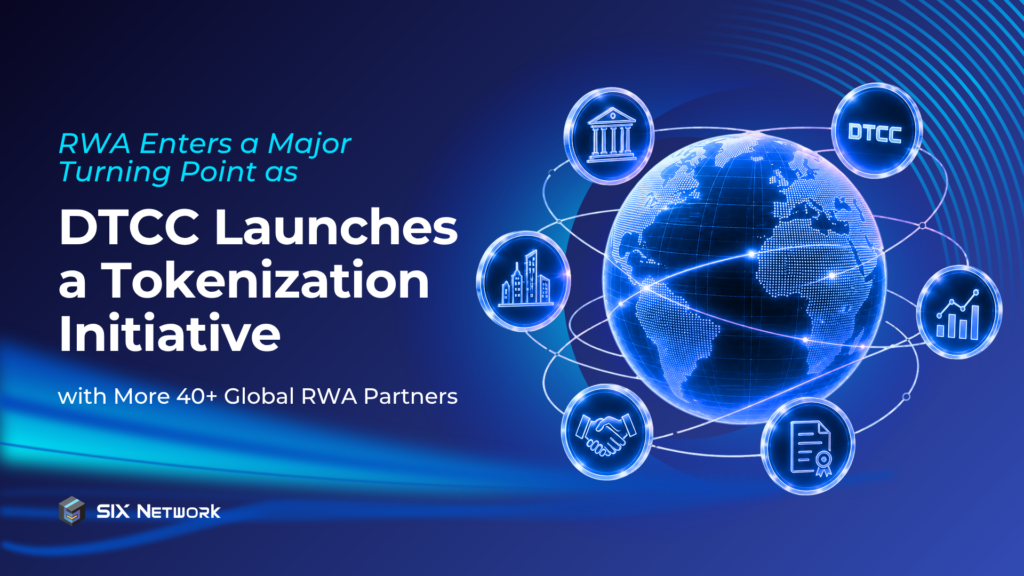
The Real-World Asset, or RWA Tokenization market, is entering another major turning point after DTCC, one of the core infrastructures of the U.S. capital market, began conducting Production Trades using tokenized U.S. securities and announced plans to launch a Tokenized Securities initiative in October, with nearly 40 leading financial institutions joining in the initial phase.
The list of participants mentioned includes BlackRock, Vanguard, JPMorgan, Goldman Sachs, and other major Wall Street players, while the assets covered in the initiative include equities, funds, and U.S. Treasury securities.
This news is therefore not simply the launch of another blockchain project. It is a clear signal that Tokenization is moving from an experimental space into the infrastructure of the real financial market.
Why DTCC’s Move Matters for RWA
DTCC is not a blockchain startup or a digital asset trading platform. It is an organization that operates behind the scenes of the U.S. capital market’s clearing, settlement, and securities data infrastructure at massive scale.
When an organization at the core of the capital market begins using Tokenized Securities in real transactions, the meaning is different from a typical Proof of Concept. This is a test of whether Tokenization technology can actually work with the existing financial system.
The first Production Trades using tokenized U.S. securities show that blockchain is being applied to existing workflows, such as:
• Collateral management
• U.S. Treasury transactions
• Equity transactions
• Securities lending
• Margin management
• Transfers and settlement between institutions
In this context, Tokenization is not about creating new assets for speculation. It is about improving how existing assets are recorded, transferred, verified, and used within the financial system.
From Digital Assets to Assets That Can Actually Work
In the early stage of the RWA market, many projects focused on bringing asset information onto blockchain or creating tokens to represent real-world assets.
However, institutional-level Tokenization has to go further than that. Tokenized assets must be usable in real financial processes, such as being used as collateral, transferred between custodians, connected to liquidity, or settled automatically under predefined rules.
This is why the collaboration between DTCC and Chainlink is interesting. It shows that the future of RWA does not depend on a single blockchain network, but on infrastructure that can connect data, assets, legacy systems, and multiple networks together.
When a tokenized asset can move and be used across multiple workflows securely, the value of tokenization will not come from simply having a token on-chain. It will come from the ability of that asset to function throughout its full lifecycle.
Wall Street Is Moving On-chain, but It Is Not Replacing the Traditional Instantly
The fact that JPMorgan, Goldman Sachs, BlackRock, Vanguard, and other major players are beginning to join Tokenization initiatives does not mean that traditional capital markets will be replaced immediately.
What is happening is the gradual integration of blockchain into existing financial systems, starting with areas where efficiency gains are clear, such as reducing settlement steps, reducing reconciliation between multiple parties, enabling real-time collateral management, and allowing assets to move in a more systematic way.
In the long term, the financial system may no longer be clearly divided between “Traditional Finance” and “On-chain Finance” in the same way it is today. Instead, the two may gradually converge through infrastructure that allows institutions to benefit from blockchain while still complying with existing regulations and standards.
This is what gives RWA long-term potential. Its growth does not depend only on crypto market narratives, but is connected to the need to improve financial systems that already handle real transaction value.
RWA Is Moving from an Asset Issuance Market to an Infrastructure Market
Until now, competition in the RWA market has often been measured by the number of assets tokenized or the total value of assets brought on-chain.
But as more institutional players enter the market, the factors that determine success may shift toward infrastructure, including:
• Asset issuance and management systems
• Identity and holder rights verification
• Compliance and transfer controls
• Real-world data connectivity
• Cross-chain interoperability
• Asset and holder lifecycle management
• Connections to settlement, custody, and secondary markets
Institutions do not only need tokens. They need systems that can fully support real-world assets, legal obligations, and business-level transactions.
How SIX Network Is Preparing as RWA Infrastructure
For SIX Network, DTCC’s move confirms the direction the market is moving toward: RWA will not end at token issuance. It requires infrastructure that enables assets to be used in practice.
The role of SIX Network is therefore not only to be a blockchain for recording transactions, but to develop the components needed to bring real-world assets into digital systems, from token issuance and management, holder rights and data management, and connections to external use cases to creating experiences that organizations and general users can actually access.
The direction for preparing infrastructure for the next phase of the market should focus on 4 key areas.
1. Institutional-ready Tokenization
Systems must be able to support assets with complex conditions, including holder restrictions, rights configuration, transfer controls, and compliance requirements across different markets.
2. Asset Lifecycle Management
Tokenization should not end on the day a token is issued. It must support data management, benefit distribution, transfers, redemption, reporting, and changes throughout the asset’s lifecycle.
3. Interoperability and Legacy System Connectivity
Institutional assets will not all exist within a single system. Infrastructure must therefore be able to connect across multiple networks, as well as with custody systems, payment systems, and existing enterprise databases.
4. User Experience That Reduces Blockchain Complexity
Mass adoption can happen when users do not need to understand wallets, gas fees, or every technical step. Tokenization systems must be designed to feel closer to general financial products.
The Key Turning Point Is Not That Wall Street Is Using Blockchain, but That Blockchain Is Entering Wall Street’s Workflows
DTCC’s news shows that tokenization is no longer at the stage where it needs to prove whether blockchain can represent assets.
The new question is what kind of infrastructure can support assets, governance, liquidity, and inter-institutional transactions in the long term.
The participation of players such as BlackRock, Vanguard, JPMorgan, and Goldman Sachs does not mean that RWA will grow in a straight line or that every project will succeed. But it is evidence that capital markets are taking this type of infrastructure seriously.
For RWA infrastructure developers, this is the period to prepare systems before real demand expands further. Once institutional assets begin moving on-chain, the competition will no longer be about who talked about Tokenization first. It will be about who has the infrastructure that can support real-world usage most completely and credibly.
Wall Street is moving on-chain. But what will make this transition possible is the infrastructure that connects assets, regulation, institutions, and users together.